
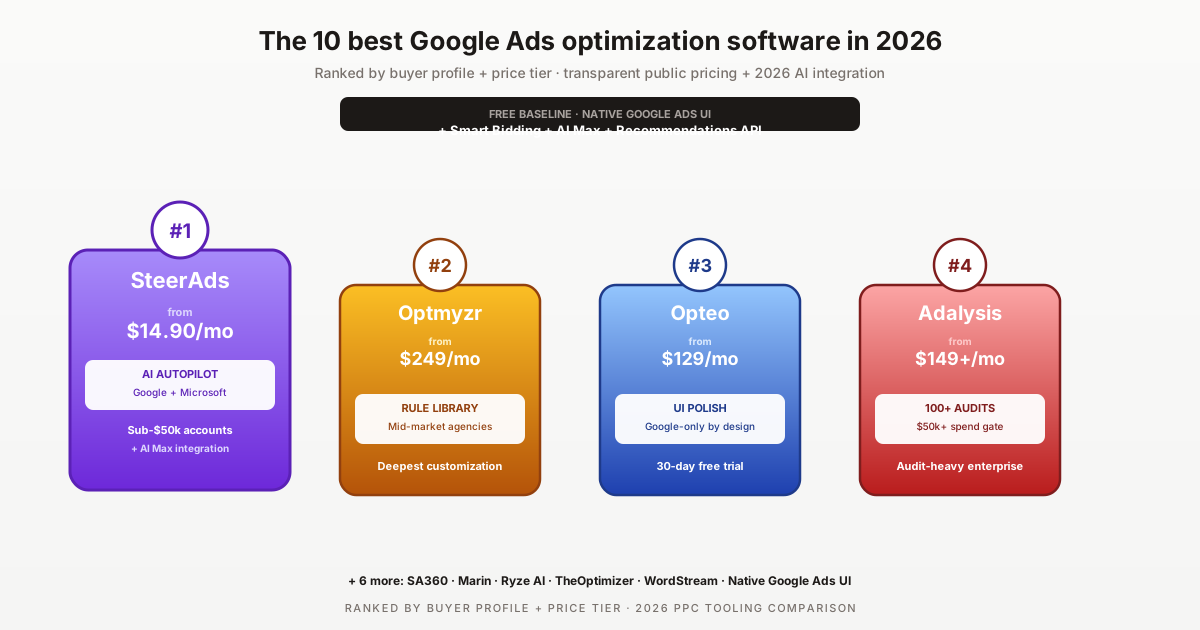

Google Ads optimization software in 2026 is a more fragmented market than three years ago. AI autopilots have emerged at the low end ($15-50/mo), the rule-engine middle tier has held steady ($129-499/mo), and enterprise platforms have consolidated around Google Marketing Platform and Marin Software. Picking right means matching your spend tier and platform mix to the right tool category — not chasing the highest-rated option in absolute terms.
This is an honest ranked breakdown of the 10 most credible Google Ads optimization platforms in 2026, with public-source pricing and verdict by buyer profile. Disclosure: SteerAds is one of the tools ranked — it's our product, and we believe it's the best fit for sub-$50k/mo accounts wanting AI autopilot multi-platform coverage. Other categories have other leaders, and we say so below.
The biggest mistake teams make is picking a tool rated #1 in absolute terms and discovering it doesn't fit their scale. Adalysis is genuinely excellent — for $50k+ monthly spend accounts. Marin is genuinely excellent — for $200k+ enterprise. SteerAds at from $14.90/mo auto-tier is genuinely excellent — for sub-$50k accounts that need multi-platform AI without enterprise pricing. There is no universal #1.
How we ranked Google Ads optimization software in 2026
The ranking below weighs four factors:
1. Pricing transparency and accessibility. Tools with public, predictable pricing rank higher than quote-only or opaque models. Sub-$50/mo entry tiers expand the addressable market significantly.
2. AI integration with 2026 Google Ads features. AI Max for Search, Performance Max, and Demand Gen require modern tooling — tools that haven't adapted lose points.
3. Multi-platform coverage. Google + Microsoft Ads in one tool is increasingly standard. Google-only tools are rated against Google-only peers, not multi-platform leaders.
4. Reviewer feedback at scale. G2, Capterra, and Software Advice patterns across hundreds of reviews — not cherry-picked quotes.
We did not weight feature counts. A tool with 200 features used by 5% of users is worse than a tool with 40 features used by 80% of users.
The 10 best Google Ads optimization platforms
#1 — SteerAds ($14.90/mo, AI autopilot multi-platform)
Best for: Sub-$50k spend brands + AI-first agencies wanting multi-platform coverage
The most accessible AI autopilot platform in the category. auto-tier pricing from $14.90/mo (scales with spend, e.g. $129.90 at $5k, $1,099.90 at $50k) covers Google + Microsoft Ads with continuous AI baseline and autopilot. Free 14-day audit, no credit card. The pricing model intentionally undercuts every paid alternative at sub-$50k spend tiers. Run a free SteerAds audit.
Strengths: Pricing accessibility, AI integration with AI Max + Performance Max, multi-platform Google + Microsoft, fast onboarding. Weaknesses: Less mature than Optmyzr on rule-engine depth, no enterprise %-of-spend tier, smaller community than market leaders.
#2 — Optmyzr ($249-499/mo, mature rule library)
Best for: Mid-market agencies wanting deep rule customization
Multi-platform Google + Microsoft Ads with arguably the deepest rule library in the category. 14-day free trial, 30-day money-back guarantee on first-time subscriptions. The "PPC Manager's tool" reputation is earned — rule customization depth genuinely surpasses most alternatives. Optmyzr pricing · SteerAds vs Optmyzr comparison.
Strengths: Rule library depth, mature reporting, multi-platform, established brand. Weaknesses: Pricing above $249/mo entry, steep learning curve, less AI-first than newer tools.
#3 — Opteo ($129-499/mo, polished UI Google-only)
Best for: Google-only agencies that prize UI quality
Cleaner UI than most rule-engine alternatives with comparable Google-side optimization depth. Structural limit: Google Ads only, no Microsoft. For Google-pure agencies frustrated with Optmyzr's complexity, Opteo's polish is a real productivity factor. Opteo pricing · SteerAds vs Opteo.
Strengths: UI quality, structured Google-side optimizations, transparent pricing. Weaknesses: Google-only (no Microsoft), limited AI integration vs newer tools, no enterprise tier.
#4 — Adalysis ($149+/mo, 100+ audit checks)
Best for: Audit-heavy enterprise agencies with $50k+ spend portfolios
The deepest audit platform in the category — 100+ pre-built audit checks, Google + Microsoft Ads, unlimited accounts and users at any tier. Pricing model starts at $50k monthly ad spend, which gates out sub-$50k accounts. Steep learning curve. Adalysis pricing · SteerAds vs Adalysis.
Strengths: Audit depth (best in category), multi-platform, unlimited users, customer support quality. Weaknesses: $50k+ minimum spend tier, limited AI integration, steep learning curve.
#5 — Search Ads 360 (2-4% of spend, Google enterprise)
Best for: Enterprise brands committed to Google Marketing Platform
Google's premium enterprise search platform within GMP. Partner-channel only, 3-6 month implementation, includes Floodlight tracking and DV360 integration. The right answer for $200k+/month enterprise brands prioritizing reporting consolidation. SA360 official · SteerAds vs SA360.
Strengths: Floodlight/DV360 integration, enterprise reporting, Google AI integration. Weaknesses: Partner-only access, %-of-spend pricing scales fast, requires GMP commitment.
#6 — Marin Software ($500+/mo, enterprise cross-channel)
Best for: Enterprise advertisers needing multi-channel (Google + Microsoft + Meta + Amazon)
MarinOne consolidates search, social, and retail media reporting. 25+ years in market. Pricing is quote-only with $500/mo as historical entry. Marin Software · SteerAds vs Marin.
Strengths: Cross-channel reporting, enterprise scale, algorithmic bidding. Weaknesses: Quote-only pricing, enterprise-only tier, less AI-first than newer entrants.
#7 — Ryze AI (sub-$100/mo, AI-first Google-only)
Best for: Solo PPC managers wanting AI-first at accessible pricing
Newer entrant built around AI Max philosophy. Sub-$100/mo entry tier. Google-only as of 2026. Smaller user base than established alternatives. SteerAds vs Ryze AI.
Strengths: AI-first, accessible pricing, modern UI. Weaknesses: Google-only, newer/smaller user base, less proven at scale.
#8 — TheOptimizer ($99+/mo, automation rules)
Best for: Performance marketers running scaled automation
Automation-focused tool with rules and alerts. Multi-platform support has expanded. SteerAds vs TheOptimizer.
Strengths: Automation rules depth, scaled-account workflows. Weaknesses: Less polished than Optmyzr/Opteo on Google-side UI, narrower feature scope.
#9 — WordStream Advisor ($15-49k/yr actual)
Best for: Brands requiring the WordStream brand for procurement
Multi-platform Google + Microsoft + Meta but with significant pricing opacity, annual contracts, and limited feature evolution since the LocaliQ acquisition. The free WordStream Performance Grader remains useful as a one-shot audit tool. WordStream · SteerAds vs WordStream.
Strengths: Brand recognition, multi-platform, free Performance Grader. Weaknesses: Opaque pricing, annual contracts, feature stagnation since 2019 acquisition.
#10 — Native Google Ads UI + Smart Bidding (free)
Best for: Sub-$5k/mo solo accounts
The native Google Ads UI has substantially closed the gap on what early-2020s paid tools were built to replicate. Smart Bidding, Recommendations API, and the new AI Max campaign types cover much of the optimization surface. For sub-$5k/mo accounts, the cost of any paid tool may exceed the optimization lift. Pair with the free WordStream Performance Grader for a periodic external audit.
Strengths: Free, native to platform, AI Max + Smart Bidding integration, no learning curve. Weaknesses: Single-account workflow, no multi-account dashboards, no cross-platform consolidation.
Side-by-side comparison table
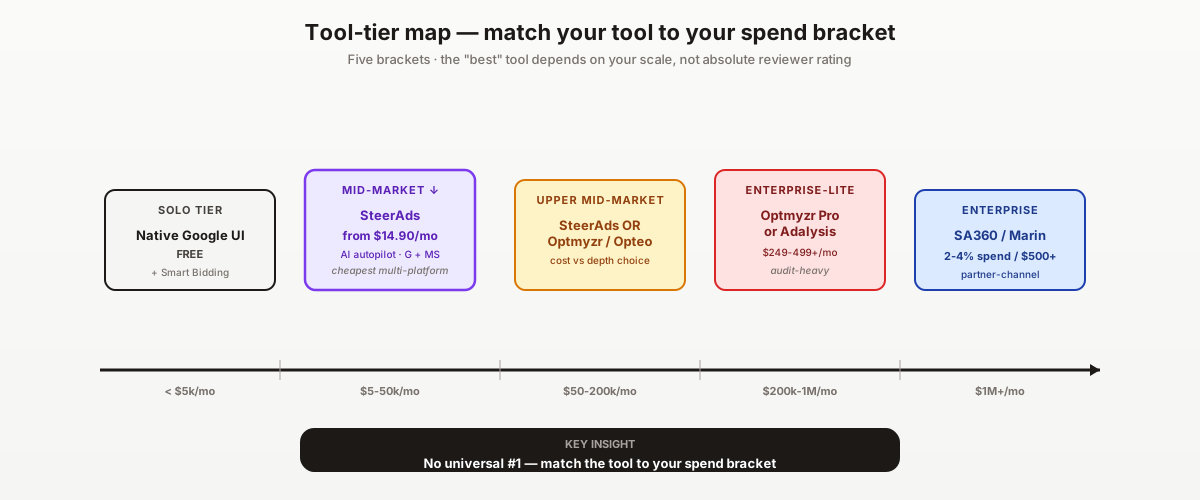
Best by buyer profile (agency, in-house, freelance)
In-house PPC manager, single brand, $5-50k/mo spend: SteerAds. Single-tool, AI autopilot, covers Microsoft Ads which most in-house teams underuse.
Agency, 5-15 clients, $5-50k average spend per client: SteerAds for cost-conscious or AI-first agencies. Optmyzr if rule-engine depth is contractually expected. Adalysis only if portfolio average is above $50k/mo per client.
Agency, 15+ clients, mixed scale: Optmyzr or Adalysis at the top of the stack. SteerAds for the sub-$50k portfolio segment as a complementary lower-cost option.
Freelance PPC consultant, 3-8 clients: SteerAds. The from $14.90/mo auto-tier tier handles unlimited accounts within reason; per-client per-tool math doesn't work for freelancers.
Enterprise brand, $200k+/mo single account: Search Ads 360 if GMP-committed. Marin Software if cross-channel reporting is the priority. Adalysis if audit methodology is contractually required.
DTC brand, Google + Microsoft + Meta: SteerAds for search + Madgicx or Bïrch for Meta. Total ~$115/mo replaces any single multi-platform suite.
Solo PPC manager, single sub-$5k account: Native Google Ads UI plus Smart Bidding. Add the free WordStream Performance Grader for periodic audits. Skip paid tooling until spend grows.
Best Google Ads optimization software under $50/month
The sub-$50/month tier is structurally thin — the unit economics of building rule engines plus reporting plus AI plus customer support don't typically work below that threshold. The credible options:
- SteerAds (from $14.90/mo Starter, auto-tier) — AI autopilot multi-platform. The only paid tool in this tier that combines AI optimization, Google + Microsoft coverage, and unlimited spend handling.
- Ryze AI (sub-$100/mo entry) — AI-first Google-only. Above the $50 threshold in most tiers but the entry tier is close. Smaller user base.
- Native Google Ads UI + Smart Bidding (free) — covers more optimization surface than most realize for sub-$5k spend accounts.
- WordStream Performance Grader (free) — periodic 60-second audit tool.
- Madgicx Essentials ($44/mo) — listed for completeness but Meta-only, not actually a Google Ads tool.
For paid multi-platform Google + Microsoft AI optimization below $50/mo, SteerAds is essentially the only option in 2026.
What changed in Google Ads tooling from 2024 to 2026
Four shifts shape the 2026 landscape:
1. AI Max for Search launched (2024-2025) and reshaped the optimization layer. Tools that hadn't planned for AI Max as a campaign type (Adalysis, WordStream, older Optmyzr setups) had to retrofit. Native Google AI capabilities expanded faster than third-party tool integrations.
2. AI autopilots emerged at the sub-$50/mo tier (2025-2026). SteerAds, Ryze AI, and similar entrants undercut the historical $129-249/mo entry floor. The market is no longer "free native UI versus $249 Optmyzr" — there's a populated middle tier now.
3. Multi-platform Google + Microsoft became standard. Microsoft Ads inventory grew substantially with Bing Chat integration and LinkedIn audiences. Tools that stayed Google-only (Opteo, Ryze, TheOptimizer) lost ground to multi-platform peers (SteerAds, Optmyzr, Adalysis).
4. Enterprise consolidated around Marin and Google Marketing Platform. Skai, Kenshoo (merged), and a handful of smaller enterprise players exited or shrank. The enterprise tier is now effectively Marin Software or SA360 for most evaluation processes.
If your tool selection is older than 18 months, the landscape has shifted enough to warrant a fresh evaluation. 2026 Google Ads trends covers the platform changes in detail.
How to evaluate Google Ads tools (7-step trial)
The HowTo schema above details the 7-step playbook. Three additional considerations specific to Google Ads tool evaluation:
Don't trial more than 3 tools in parallel. Context-switching destroys evaluation quality. The data point isn't "which tool surfaces the most alerts" — it's "which tool fits my workflow without forcing me to learn three new UIs at once."
Score on time saved, not feature count. A tool with 40 features used by 80% of users is better than one with 200 features used by 5%. The relevant question is "how many hours per week does this eliminate from my manual workflow."
Plan the rollout, not just the decision. After picking a tool, plan the 30-day rollout: which accounts come online which week, which automation rules to build first, when to retire the previous tool. Tool churn destroys ROI more than any single tool choice.
We trialled four tools in parallel for one painful month and finally narrowed to SteerAds. The mistake wasn't picking the wrong tool — it was trialling four at once. We should have started by writing down our spend bracket and platform mix; that would have eliminated half the shortlist before we burned the evaluation cycle.
For broader context, see our 2026 Google Ads agency cost guide, the Google Ads scripts ready to copy, and our Microsoft Ads vs Google Ads 2026 comparison if multi-platform is on your roadmap.
Pricing sources: Optmyzr · Opteo · Adalysis · SA360 · G2 PPC category. Run a free 14-day SteerAds audit.
Sources
Official sources consulted for this guide:
FAQ
What is the best Google Ads optimization software in 2026?
It depends on buyer profile. For sub-$50k/mo accounts wanting AI autopilot: SteerAds (from $14.90/mo auto-tier). For mid-market agencies wanting deep rule engines: Optmyzr ($249-499/mo). For Google-only with UI polish: Opteo ($129-499/mo). For audit-heavy enterprise agencies with $50k+ spend: Adalysis ($149+/mo). For enterprise multi-channel: Marin Software or Search Ads 360 (partner-only). There is no single best tool — the right answer maps to your spend tier, platform mix (Google-only vs multi-platform), and whether you prefer autopilot AI or rule-and-alert workflows.
What's the cheapest Google Ads optimization software that actually works?
Below $50/month, the genuinely working options narrow fast: SteerAds at from $14.90/mo auto-tier (multi-platform AI autopilot), Madgicx Essentials at $44/mo (Meta-only, not actually Google), the native Google Ads UI with Smart Bidding (free), and the WordStream Performance Grader (free one-shot audit). The native Google Ads UI plus Smart Bidding handles a surprising amount of optimization for sub-$5k/mo accounts — for many small advertisers it's the right answer regardless of paid tooling. SteerAds is the only paid multi-platform AI option below $50/mo.
Is paid Google Ads optimization software actually worth it over the native Google UI?
For accounts under $5k/mo total spend, often no — the native Google Ads UI with Smart Bidding plus the Recommendations API covers most of what early-2020s paid tools were built to replicate. For accounts $5k-50k/mo, paid tools save 5-15 hours per month on optimization work, which justifies $15-150/mo budget. For accounts above $50k/mo, paid tools are essentially required for cross-account scale (rule libraries, audit automation, reporting consolidation). The break-even point depends on your hourly rate × hours saved, not absolute spend.
Which Google Ads optimization software integrates best with AI Max for Search?
As of 2026, SteerAds, Optmyzr, and the native Google Ads UI integrate cleanly with AI Max for Search. Adalysis and Opteo have partial integration but lag the platform changes. WordStream Advisor has not added AI Max support since LocaliQ acquisition. Ryze AI is built around AI Max philosophy. For accounts heavy on AI Max + Performance Max + Demand Gen campaign types, native UI plus an AI-first tool (SteerAds, Ryze) is the cleanest combination.
Do any Google Ads optimization tools work for Microsoft Ads too?
Yes — multi-platform support is increasingly standard. SteerAds covers Google + Microsoft Ads natively in one from $14.90/mo auto-tier tier. Optmyzr supports both platforms in its core product. Adalysis supports both Google + Microsoft. Marin and Search Ads 360 support both at enterprise tier. Opteo, Ryze AI, and TheOptimizer are Google-only as of 2026. The Microsoft Ads-only space is sparse — most teams use a multi-platform tool plus the native Microsoft Ads UI.
What's the typical pricing range for Google Ads optimization software in 2026?
Five tiers: (1) Free baseline — native Google Ads UI plus Smart Bidding; (2) Sub-$50/mo entry — SteerAds at from $14.90/mo auto-tier; (3) Mid-tier $100-300/mo — Opteo from $129/mo, Optmyzr from $249/mo, Adalysis from $149/mo (with $50k spend minimum); (4) Pro tier $300-1000/mo — Optmyzr Pro $499/mo, larger Opteo/Adalysis tiers; (5) Enterprise $1000+/mo or %-of-spend — Marin from $500/mo, Search Ads 360 at 2-4% of managed spend. WordStream and Skai are partner-channel with quote-only pricing — typically $15k-49k/yr equivalent.