


The WordStream brand is one of the most recognized names in PPC tooling — it's been around since 2007 and the free Google Ads Performance Grader has been a consistent acquisition magnet. But "recognized brand" and "best fit for your account in 2026" are different questions, and the post-LocaliQ-acquisition trajectory has changed how the product compares to newer alternatives.
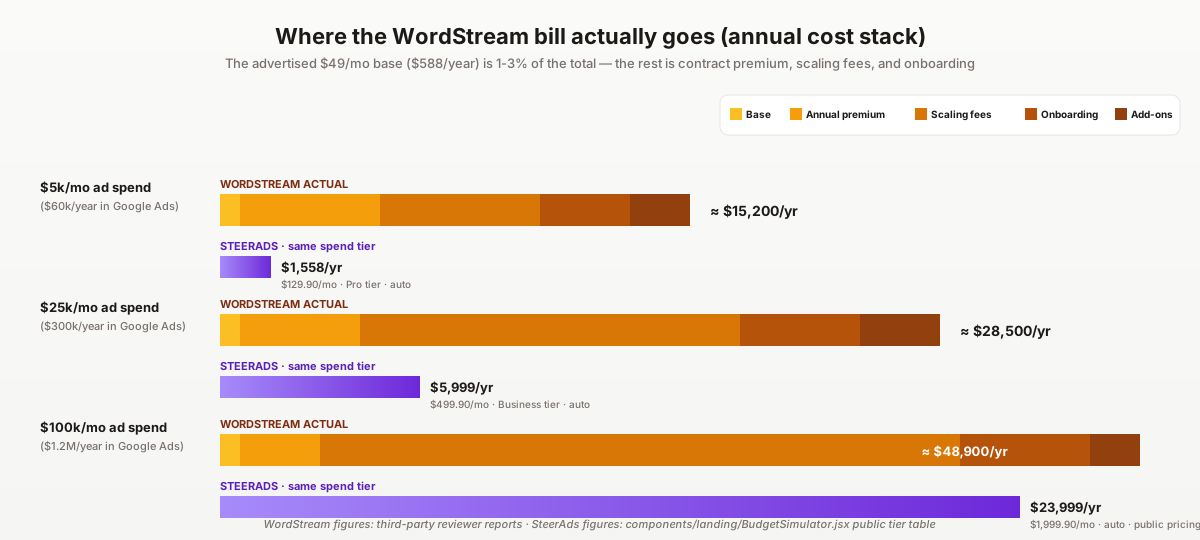
WordStream's published pricing starts at $49/month, but third-party reviewers consistently report total annual costs in the $15,000–$49,000 range once annual contracts, scaling fees, and onboarding charges are factored in. SteerAds runs at from $14.90/month auto-tier. This is an honest comparison with public sources for every claim.
WordStream does not publish complete tier-by-tier pricing on its public site. The figures in this article come from third-party review aggregators and agency case studies. We strongly recommend requesting a full written quote (with all scaling fees and contract terms) directly from WordStream before signing anything.
WordStream in 2026: snapshot
WordStream Advisor (the paid SaaS) sits alongside the free Google Ads Performance Grader (the lead-magnet audit tool). The Advisor product targets Google Search and Display optimization with rule-based suggestions, performance reports, and multi-account dashboards. It supports Microsoft Ads and historically supported Meta Ads, though reviewers consistently note non-Google platforms receive less product depth.
The brand was acquired by Gannett (parent of LocaliQ) in 2018. Post-acquisition, agency-published reviews note slower feature release velocity and a documented talent exodus among the PPC specialist and engineering teams. The current product still works — it's a mature, stable platform — but the "what's new" cadence has slowed materially compared to AI-first competitors that emerged in 2022-2024.
The free Google Ads Performance Grader remains genuinely useful as a one-shot diagnostic. It runs a 60-second audit on a connected Google Ads account and outputs a scored report (Quality Score, wasted spend, ad text quality, account structure). Many teams use it as a quick health check before deciding whether to engage the paid Advisor product.
Pricing reality (advertised vs actual)
WordStream is the most opaque pricing in the PPC tooling category. Advertised prices and actual costs are often disconnected.
The structural pattern: WordStream's pricing model is built for annual enterprise contracts, not monthly SaaS subscriptions. If you're a startup or small business comparing $14.90/month vs "$49/month" — those numbers aren't actually comparable on equivalent terms. Ask WordStream for a full written quote including all scaling fees, contract length, and termination conditions before signing. The single most common 2026 reviewer complaint is "I didn't realize what I was actually committing to."
Feature parity
Both products optimize Google Ads and (less robustly) Microsoft Ads. Neither is a strong Meta Ads tool in 2026. Inside that scope, the feature depth differs:
The WordStream value proposition in 2026 is: "established brand, mature feature set, professional report templates, and a useful free audit tool." The trade-offs are: annual contracts, higher real cost, slower roadmap, and a rule-based optimization model that AI-first tools have moved past.
Where WordStream genuinely wins
Three honest scenarios where WordStream remains the better choice, based on 2026 reviewer patterns and agency-published case studies:
1. Mature in-house teams with established WordStream-driven processes. If your team has built training, documentation, and reporting workflows around WordStream Advisor over multiple years, the switching cost is real. Custom report templates, account structure conventions, and team muscle memory all reset on tool change. For a team in steady-state where WordStream is "good enough," staying is rational.
2. Top-of-funnel lead generation via Performance Grader. The free Google Ads Performance Grader is a legitimately strong acquisition asset for agencies that use it to qualify prospects. White-labeled or co-branded use of the Grader (where available) creates a sales-enablement workflow that competitor tools don't replicate.
3. Enterprise procurement environments that require annual contracts. Some large organizations' procurement processes prefer annual SaaS contracts with a single PO over monthly subscriptions. If your procurement team will not approve a $14.90/month subscription but will approve a $49/month annual contract, WordStream's structure matches the constraint better. (This is a procurement quirk, not a product advantage — but it's real.)
If none of those three describe you, the math points elsewhere.
Where SteerAds wins
Four scenarios where SteerAds is the better fit, in our experience:
1. Pricing transparency. SteerAds publishes its full pricing on the website. $14.90/month, no scaling fees, no annual lock-in, no onboarding fees, cancel anytime. WordStream requires a sales conversation to learn what you'll actually pay. For decision-makers who value being able to evaluate cost without a sales call, this is decisive.
2. AI auto-optimization vs rule-based suggestions. WordStream's optimization model is rule-based: you configure thresholds, the platform suggests actions, you approve or reject. SteerAds's model is AI baseline + autopilot: the system establishes a continuous baseline of expected performance, identifies deviations, and acts on the higher-confidence ones automatically. The mental load is different — you stop maintaining rules and trust the system to keep adapting.
3. Microsoft Ads parity. Both tools support both platforms. SteerAds was built multi-platform from day 1 with the same depth on Microsoft Ads as on Google Ads. WordStream's reviewer feedback consistently notes Microsoft-side gets less product attention. If 30%+ of your spend is on Bing/Yahoo/AOL, this matters. For deeper context see our Microsoft Ads vs Google Ads 2026 comparison.
4. No annual contract risk. WordStream's annual contracts mean a wrong fit is a 12-month problem. SteerAds is monthly — a wrong fit is a 30-day problem. For SMB advertisers who don't have the leverage to negotiate WordStream's contract terms, this risk asymmetry alone justifies the choice. Run a free 14-day SteerAds audit on your account before deciding.
Migration cost & switching playbook
The migration cost from WordStream to SteerAds is dominated by the annual contract structure, not by technical complexity. The HowTo schema above details a 75-day playbook timed to the WordStream contract renewal cycle — the strategic choice point is "do not renew" rather than "cancel mid-term."
Three deal-breakers to watch during the parallel-run period:
- A WordStream report layout that's contractually expected by a key client (replicate it before switching, not after)
- A WordStream-driven workflow your team relies on without realizing it (audit checklist, monthly review template — these are easy to replace but only if you remember they exist)
- A Microsoft Ads coverage gap if your account is heavily Bing-weighted (validate SteerAds parity during the shadow period)
For broader context on PPC tool selection, see our in-house vs agency vs freelance comparison and the 2026 Google Ads agency cost guide.
What G2 and TrustRadius reviewers actually say (2026)
Aggregating themes across G2 reviews, Capterra reviews, and agency-published case studies on why teams switch away:
We signed for $49/month and ended the year having paid $22,000. The advertised price isn't a lie — it's the base subscription — but everything that makes the platform useful at agency scale lives in the add-ons, scaling fees, and onboarding line items the sales call didn't dwell on.
Most-cited strengths:
- Free Google Ads Performance Grader: nearly universal mention, even from critics. Genuinely useful diagnostic, no signup required.
- Professional PDF reports: clean design, easy to send to clients, well-suited for agency workflows.
- Mature feature set on Google Search and Display: reviewer consensus is "what it does, it does competently."
- Established brand + documentation: easier internal sell to risk-averse decision-makers.
Most-cited frustrations:
- Pricing opacity: "I didn't know what I'd actually pay" appears repeatedly across review platforms.
- Annual contract friction: difficulty cancelling mid-term, negotiation needed up front.
- Repetitive optimization suggestions: as accounts mature, the rule-based suggestions surface the same patterns each month.
- Limited automation depth: AI-first competitors have moved past WordStream's rule-based model.
- Slow roadmap since 2019: feature gaps with newer tools have widened materially.
- Customer support quality reported as inconsistent post-2019: some reviewers note slower response times than historical norms.
Best-fit user profile per reviewer consensus:
WordStream Advisor in 2026 is best for established teams with mature workflows already built around the platform. New buyers are increasingly looking elsewhere — the brand recognition that historically drove acquisition is no longer enough to overcome the pricing opacity and contract friction concerns.
Verdict by buyer profile
Solo founder or in-house manager (single account, $5k-50k monthly spend): SteerAds. The WordStream pricing model is structurally hostile to single-account small spenders. Use the free WordStream Performance Grader as a one-shot baseline, then move on.
Agency (10+ client accounts, established WordStream workflows): Closer call. If you've spent years building report templates and team training around WordStream, the switching cost is real. Run a parallel evaluation timed to your contract renewal cycle. If the savings are >$10k/year and SteerAds delivers comparable optimization output, the math eventually wins.
Solo freelance PPC manager (3-10 accounts): SteerAds. WordStream's per-account pricing makes a freelance practice expensive at scale. SteerAds's auto-tier pricing aligns with how a freelancer charges clients.
Enterprise in-house team ($500k+ monthly spend, procurement requires annual contracts): Closer call. WordStream's contract model fits some procurement environments better. Negotiate the contract terms aggressively (pro-rated refund, early termination conditions) — don't accept the standard offer.
For a fuller competitive overview, see our SteerAds vs WordStream feature page, our Google Ads agency cost guide, or contact sales for an apples-to-apples enterprise quote.
Sources
Official sources consulted for this guide:
FAQ
Why is WordStream so much more expensive than its advertised starting price?
WordStream Advisor's published pricing starts at $49/month for the Starter tier, but third-party reviewers consistently report total annual costs in the $15,000-$49,000 range. The gap comes from three structural factors: (1) annual contracts are typical (month-to-month is either unavailable or significantly more expensive), (2) the platform employs scaling fees tied to ad spend that increase as your campaigns succeed, and (3) onboarding fees and integration charges are common. The honest framing: WordStream is priced like an enterprise platform, not a SaaS. SteerAds at from $14.90/month auto-tier is in a different pricing model entirely.
Has WordStream's product evolved since the LocaliQ acquisition?
Multiple 2026 reviews note that WordStream's core feature surface area has not significantly evolved since 2019, around the time of the Gannett/LocaliQ acquisition. Newer competitors have integrated machine-learning-driven optimization (continuous AI baselines, automated bid landscape exploration, conversational query interfaces); WordStream Advisor's optimization model remains rule-based with the same pre-built suggestions structure. This isn't necessarily a deal-breaker — rule-based suggestions still work — but the gap to AI-first tools has widened materially over the past 4 years.
Is WordStream's free Google Ads Performance Grader still useful?
Yes, it's a legitimately useful free audit tool that has been WordStream's strongest top-of-funnel asset for years. It runs a 60-second analysis on connected Google Ads accounts and outputs a scored audit (Quality Score, wasted spend, ad text optimization, etc.). Both newcomers and established teams use it as a quick health check. SteerAds offers a similar free 14-day audit (no credit card) that goes deeper across more axes. Use both — they complement each other on the diagnostic level.
Can I cancel WordStream mid-contract if it doesn't work for my account?
Annual contracts are typical and 2026 reviewers across multiple platforms (TrustRadius, Capterra, agency case studies) cite cancellation friction as a recurring frustration. The honest advice: if you're evaluating WordStream, negotiate the contract terms upfront — specifically pro-rated refund language and early termination conditions. Don't sign assuming you can exit easily. SteerAds operates on standard SaaS month-to-month terms; if it doesn't work, you cancel and stop paying the next month.
Does WordStream support Microsoft Ads, Meta Ads, or just Google?
WordStream Advisor's strongest surface is Google Search and Display. It also supports Microsoft Ads and historically supported Meta (Facebook) Ads, but reviewers consistently note the non-Google platforms receive less product attention and feature depth. If 30%+ of your spend is on Microsoft Ads or Meta, evaluate carefully. SteerAds focuses on Google + Microsoft Ads only — narrower scope, more depth on each.
Is the LocaliQ talent exodus from WordStream a real concern?
It's a documented pattern in agency-published case studies: post-acquisition, several experienced PPC specialists and engineers left WordStream/LocaliQ. This affects support quality (longer response times reported in 2026) and feature roadmap velocity (slower releases vs. 2018-2019 cadence). It does not break the existing product — but it explains why feature parity gaps with newer entrants have widened. Factor this into your buy decision: you're buying a mature product with a steady-state team, not a fast-iterating startup.