
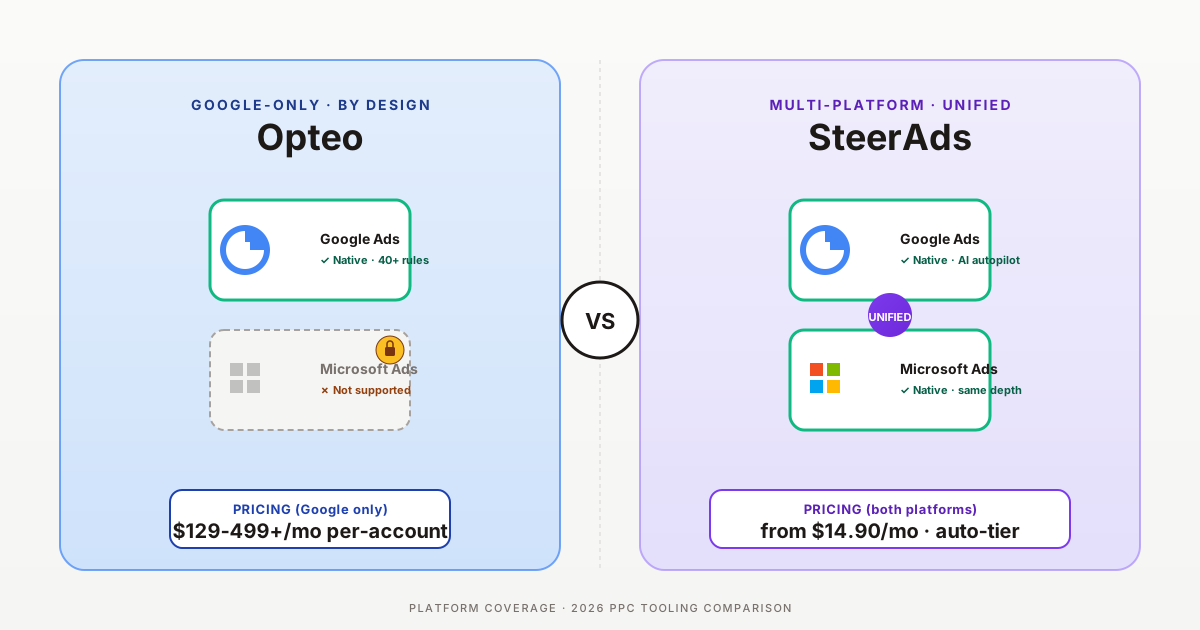

Opteo is one of the most polished tools in the rule-based PPC optimization category — a London-based product with strong G2/Capterra ratings, 40+ pre-built optimizations, and a refreshingly clean UI. Its 2026 pricing starts at $129/month for accounts under $25k spend. SteerAds runs auto-tier pricing from $14.90/month (covering Google + Microsoft Ads).
The structural difference that matters most for buyer choice: Opteo is Google Ads only. No native Microsoft Ads connection, by deliberate product strategy. SteerAds covers both. If your account split makes Microsoft Ads irrelevant, this matters less; if it's 20%+ of your spend, it's the decision.
This is an honest comparison with public sources for every claim.
Pricing comes from Opteo's public pricing page (verified 2026). Reviewer themes are aggregated from G2, Capterra, TrustRadius, and SelectHub. We do not cite private benchmarks or unverifiable user counts. Where a claim is opinion, we flag it as "in our experience."
Opteo in 2026: snapshot
Opteo launched as a Google Ads optimization platform built around continuous account monitoring and rule-based recommendations. Its core loop: watch the account, surface 40+ types of optimization opportunities (keyword bids, budget pacing, ad schedule, search terms, ad copy A/B suggestions, alerts), and offer 1-click application back to Google Ads without having to leave the Opteo UI.
The product is consistently praised for UX polish, time savings, and customer support quality on review platforms. The 30-day free trial (no credit card) is among the most generous in the category.
The strategic constraint: Opteo has chosen to focus narrowly on Google Ads. The Opteo team has publicly clarified this is a deliberate decision rather than a backlog item, citing the depth required to do Google Ads well. For some teams that's a feature (focused depth); for others it's a deal-breaker (need multi-platform).
Pricing comparison (with sources)
Opteo's pricing scales with managed ad spend and account count, like most agency-oriented PPC tools. SteerAds auto-tier scales proportionally to spend-rate.
For a single-account in-house manager spending $30k/month on Google Ads only, Opteo Basic at $129/month is technically affordable. But you're paying for capacity (10 accounts) you don't use. SteerAds at $14.90/month delivers the same optimization-on-autopilot value without that surplus. Opteo's pricing is rational for agencies running 5-10+ client accounts; less so for single-account use cases.
Feature parity (and the Microsoft Ads gap)
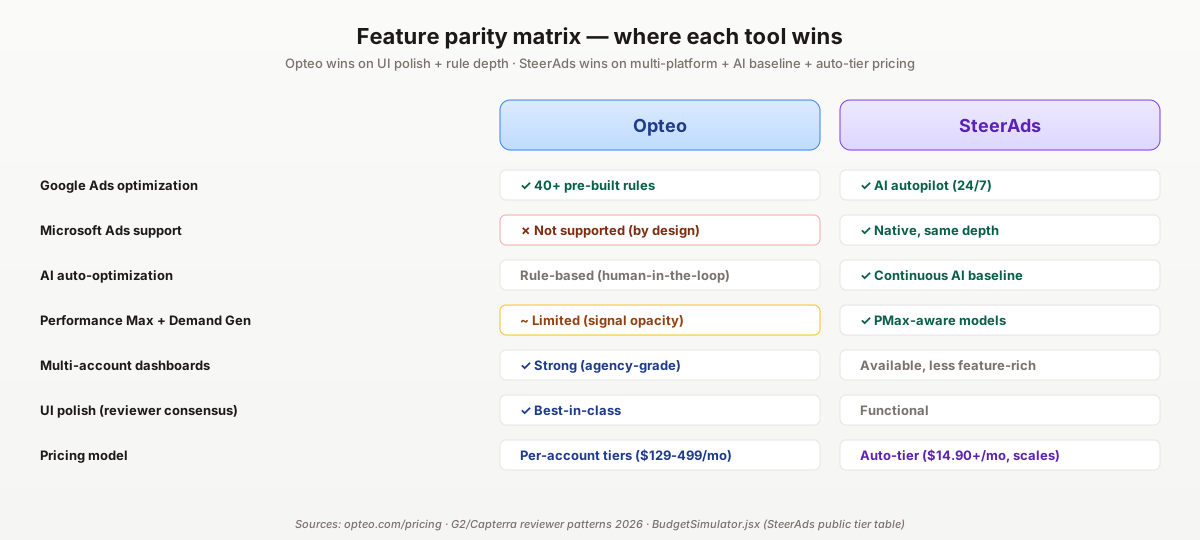
Within Google Ads optimization, Opteo and SteerAds have substantial overlap. The structural differences are scope (Google-only vs Google + Microsoft) and optimization model (rule-based vs AI baseline).
The mental model: Opteo is a category-leading Google Ads optimization tool with a refined UI for the rule-based optimization workflow. SteerAds is a multi-platform AI-first autopilot that aims to do for both platforms what Opteo does for Google, but trades UI polish for automation depth. For agencies that already love Opteo's interface and don't need Bing, this is a hard trade. For Bing-relevant accounts, SteerAds is the only option that covers both platforms in one subscription.
Where Opteo genuinely wins
Three honest scenarios where Opteo remains the better fit, based on G2/Capterra reviewer patterns:
1. Google-only agencies that prize UI polish. If your team has standardized on Opteo's daily review-and-apply workflow and your client base is 100% Google Ads, the SteerAds switch primarily delivers cost savings — the optimization output overlap is high. For teams that genuinely enjoy using Opteo (UI quality is a real productivity factor), staying is rational.
2. Multi-account portfolios where the per-account economics work. At the Agency tier ($499/month for 75 accounts), Opteo's per-account cost is $6.65/month — competitive with anything else in the category. If you're already running 30+ Google Ads accounts and not adding Microsoft Ads, the math doesn't push you toward switching.
3. Teams that value the human-in-the-loop optimization model. Opteo surfaces recommendations and waits for human approval before applying. SteerAds's autopilot makes decisions automatically (with logs and override controls). For teams in regulated industries or with brand-sensitive accounts, the explicit-approval model is a hard requirement.
If those don't describe you, the math points elsewhere.
Where SteerAds wins
Four scenarios where SteerAds is the better fit:
1. Microsoft Ads matters at all. If even 10% of your aggregate spend touches Bing/Yahoo/AOL, Opteo cannot help with that portion. You'd be paying $129+/month for partial coverage. SteerAds delivers full coverage for $14.90/month. The decision becomes binary the moment Microsoft Ads is in scope. See our Microsoft Ads vs Google Ads 2026 comparison for context on when Bing matters.
2. Single-account in-house manager. Opteo's Basic tier ($129/month for 10 accounts) is overkill for a single-account use case. SteerAds at $14.90/month is the rational choice for in-house teams running their own ads on a single brand.
3. Newer Google campaign types (PMax, Demand Gen). Opteo's rule-based model works best on Search and Shopping campaigns where the signal granularity is high. Performance Max and Demand Gen expose less actionable signal at the rule level — the campaigns are designed for Google's own AI. SteerAds's AI baseline model adapts more cleanly to opaque-by-design campaign types.
4. Cost predictability at scale. A retailer scaling from $50k to $200k monthly spend will move from Opteo Pro ($249/mo) to Agency ($499/mo) — a doubling. SteerAds auto-tier scales proportionally with spend (~$1,099.90/mo at $50k, ~$1,999.90/mo at $100k, ~$4,499.90/mo at $250k) — no manual tier upgrade required. Total cost of ownership becomes predictable, which matters for budget planning. Run a free 14-day SteerAds audit to see what changes the AI would make on your account.
Migration cost & switching playbook
The Opteo → SteerAds migration is the easiest of all the vs-competitor migrations because both products use monthly billing — no annual contract friction. The 30-day playbook in the schema above (audit existing Opteo workflow → connect SteerAds read-only → 14-day shadow → switch autopilot on subset → decide on cancellation) is near-zero-risk.
The interesting strategic question for many teams isn't "switch or stay" but "should I run both?" The case for running both:
- Keep Opteo for Google Ads campaign-builder workflows (the UI is genuinely productive there)
- Add SteerAds for Microsoft Ads coverage (which Opteo doesn't have) and for the autopilot reduction in routine optimization workload
- Total cost: $129/month Opteo Basic + $14.90/month SteerAds ≈ $145/month — still cheaper than Optmyzr Pro alone
The case against running both: tool sprawl. Two systems making decisions on the same account creates conflicts and audit-trail confusion. For most teams, picking one is the better answer.
For broader context on PPC tooling decisions, see our in-house vs agency vs freelance comparison.
What G2 and Capterra reviewers actually say (2026)
Aggregating themes across G2, Capterra, and TrustRadius in 2026:
Opteo has the cleanest UI of any PPC tool I've used in 8 years. It's also the only one that made me cry when I realized I'd have to switch tools the day my client added a $40k/month Microsoft Ads budget. The team's deliberate Google-only focus is a feature for them and a hard constraint for me.
Most-cited strengths:
- UI polish and ease of use: "incredibly user-friendly" appears in nearly every 5-star review. This is real and measurable.
- Time savings on routine optimization: agencies report saving multiple hours per week per account on bid adjustments, negative keywords, and ad rotation.
- Customer support quality: fast, knowledgeable, responsive — repeatedly cited as a differentiator.
- 30-day free trial: most-praised onboarding in the category, no credit card friction.
Most-cited frustrations:
- No Microsoft Ads support: the most-requested feature for years, repeatedly declined by the Opteo team. Multi-platform managers cite this as the deal-breaker.
- Pricing for small accounts: "expensive if you're starting out" is a recurring theme.
- Some contradictory recommendations: rule-based suggestions occasionally conflict (one suggests pausing what another would expand). Review before applying is mandatory.
- Slower adaptation to PMax / Demand Gen: the rule-based model lags behind Google's newer AI-driven campaign types.
Best-fit user profile per reviewer consensus:
Opteo in 2026 is best for agencies and freelance PPC managers running 5-25 Google-only accounts who value UI quality and willingness to do daily review-and-apply work. The fit weakens for: single-account in-house teams (overkill capacity), Microsoft-Ads-relevant accounts (no coverage), and teams that want pure autopilot (the human-in-the-loop model is opt-in, not optional).
Verdict by buyer profile
In-house PPC manager (single account, Google Ads only): SteerAds. Opteo Basic is overkill capacity for a single account; SteerAds's auto-tier pricing is rational.
In-house PPC manager (single account, Google + Microsoft Ads mix): SteerAds. Opteo can't cover Microsoft. No further analysis needed.
Agency (5-25 client accounts, Google-only, mature daily-review workflow): Closer call. If you and your team genuinely love Opteo's UI and Bing isn't on the table, staying is fine. If cost matters and you can adopt the autopilot mental model, SteerAds saves $1k+/year per active account.
Agency (any size, Microsoft Ads in scope): SteerAds, mandatory. Opteo cannot serve the Microsoft portion of any client account.
Solo freelance PPC manager (3-10 Google-only accounts): Closer call. Opteo Basic at $129/month is fine economics for a freelance practice. SteerAds saves money if you can run more autopilot, less hands-on.
For a fuller competitive overview, see our SteerAds vs Opteo feature page, our PPC in-house vs agency vs freelance comparison, or contact sales for a multi-account quote.
Sources
Official sources consulted for this guide:
FAQ
Does Opteo support Microsoft Ads (Bing) at all?
No. As of 2026 Opteo remains Google Ads only — no native Microsoft Ads connection. The Opteo team has publicly stated this is a strategic focus rather than a roadmap gap. If your account split is Google-only, this is a non-issue. If 20%+ of your spend is on Microsoft Ads (Bing/Yahoo/AOL), Opteo cannot help with that portion of the account, and you'd need a second tool. SteerAds covers both platforms in a single subscription.
How does Opteo's pricing compare to SteerAds for a $50k/month spend account?
Opteo's Pro tier ($249/month, up to $100k ad spend, 25 accounts) covers a $50k account comfortably. SteerAds auto-tier pricing adjusts with spend (~$129.90/mo at $5k, ~$1,099.90/mo at $50k). The math: at $50k spend SteerAds lands at ~$1,099.90/mo vs Opteo Pro at $235/mo for a single account — so the calculation flips depending on your actual spend tier. The Opteo price reflects the depth of the rule library and the polish of the UI; the SteerAds price reflects a different business model. Neither is automatically right — it depends on what you actually use.
Is Opteo a good fit for in-house teams or only for agencies?
Opteo's user reviews skew toward agencies and freelance PPC managers handling multiple client accounts. The per-account pricing model, multi-account dashboard, and white-label-friendly reports are agency-shaped. In-house teams managing a single account can use it but pay disproportionately for capacity they don't need (the Basic tier still gives you 10 accounts). For a single-account in-house manager, SteerAds's auto-tier pricing is more rational.
Has Opteo's optimization model kept up with Google Ads' AI features (Performance Max, Demand Gen, Smart Bidding)?
Mixed. 2026 reviewers consistently note that Opteo's rule-based suggestion model — strong for traditional Search and Shopping campaigns — feels increasingly thin against newer Google campaign types where Google's own AI handles much of the optimization. Performance Max in particular doesn't expose the granular signal Opteo's rules need. The Opteo team continues iterating, but the gap to AI-first tools that adapt their model to whatever Google introduces is real.
What's the typical migration time from Opteo to SteerAds?
Plan for 14 days of overlap. Opteo's 30-day free trial on the SteerAds side combined with Opteo's monthly billing (no annual lock) makes this the easiest of all the vs-competitor migrations. Day 1-3: connect SteerAds read-only alongside Opteo. Day 4-14: parallel-run shadow comparison tracking the same KPIs. Day 15: switch SteerAds to autopilot, Opteo to read-only observation. Day 30: cancel Opteo if no regression detected. The lack of contract friction makes this near-zero risk.
Can Opteo's 1-click optimizations break my account?
Used carelessly, yes — any optimization tool can. Opteo's optimizations are reviewable before applying (you see the recommendation and approve), which mitigates risk on the human-in-the-loop axis. 2026 reviewers note that some recommendations are 'contradictory' (one optimization suggests pausing keywords that another would expand) — review before clicking is mandatory, not optional. SteerAds's autopilot model trades approve-each-action control for continuous AI baseline tuning; the trust model is different but neither is inherently safer.