
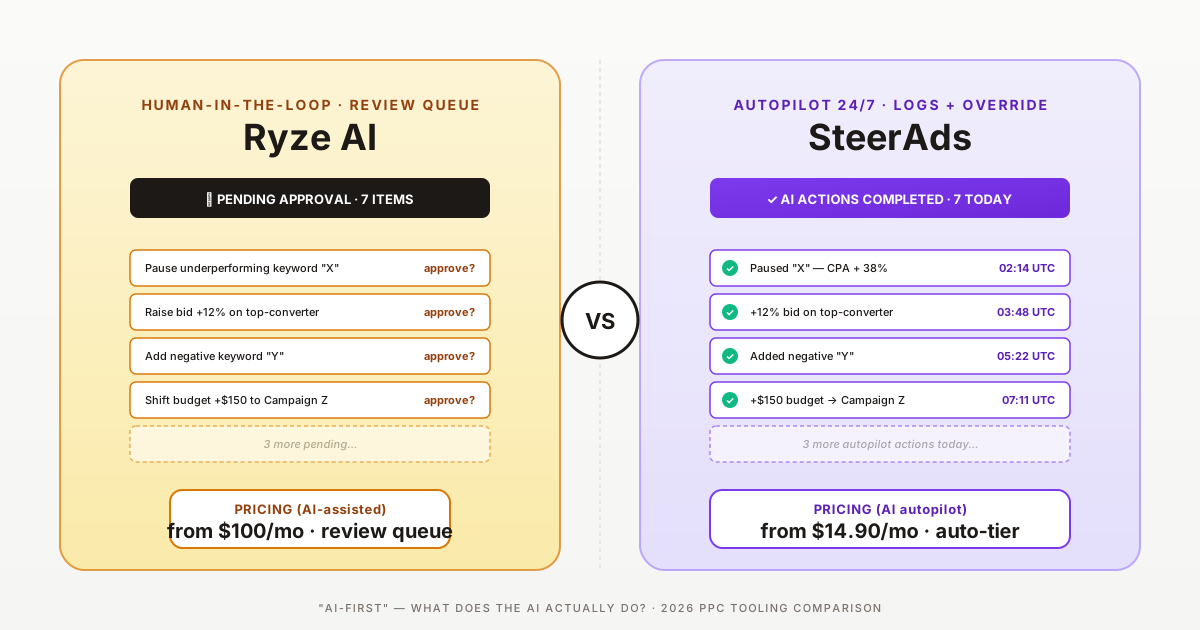

Ryze AI is one of the newer entrants in the AI-marketed PPC tooling category. Its 2026 pricing starts at $100/month and scales with ad spend. The product covers Google Ads and Meta with a distinctive feature: ChatGPT/Perplexity integration via Model Context Protocol (MCP). SteerAds runs at from $14.90/month auto-tier for Google + Microsoft Ads.
Both products use the "AI-first" marketing language. The honest comparison reveals that the trust models differ materially: Ryze AI surfaces recommendations for human approval; SteerAds operates autopilot on high-confidence decisions. This is an honest comparison with public sources.
"AI-powered optimization" is now table-stakes marketing language across the PPC tooling category. The substance varies: some tools surface AI-generated recommendations for approval, others execute decisions autonomously. The trust-model question matters more than the AI label — what you're actually buying is a particular point on the autonomy spectrum.
Ryze AI in 2026: snapshot
Ryze AI launched as an AI-driven optimization layer for Google Ads and expanded to include Meta. The 2026 product is positioned as "AI that manages ads in Google, Meta, ChatGPT, and Perplexity" — the ChatGPT/Perplexity reference is about their MCP integration that lets users ask natural-language questions about their accounts.
The product's 2026 reviewer consensus is mixed. The strengths are real: fast time-to-value (first bid adjustments within 4 hours per testimonials), reports that clients understand, novel ChatGPT MCP interface for conversational PPC management. The weaknesses are also real: every recommendation requires manual approval (the "AI" doesn't actually make autonomous decisions), the platform "struggles at scale" per repeated reviewer feedback, and the onboarding lacks strategic assessment.
The product targets small-to-mid-sized businesses and marketers who want to simplify campaign optimization without deep PPC expertise. The entry price of $100/month positions it above SteerAds ($14.90) but well below Optmyzr ($249) or Adalysis ($149) — a middle-tier price point.
Pricing comparison (with sources)
Both products use monthly billing. Ryze AI scales with ad spend; SteerAds auto-tier scales proportionally to spend-rate.
For an SMB account spending $10-30k/month, the price difference is structural: $14.90 (Starter ≤$500 spend) vs $100+ for similar surface area at low spend. For higher-spend accounts where Ryze AI's pricing scales further, the gap widens. SteerAds's auto-tier transparency is the dominant advantage at lower spend for cost-conscious buyers; Ryze AI's price reflects the additional features (MCP integration) and the explicit-approval workflow that some buyers prefer.
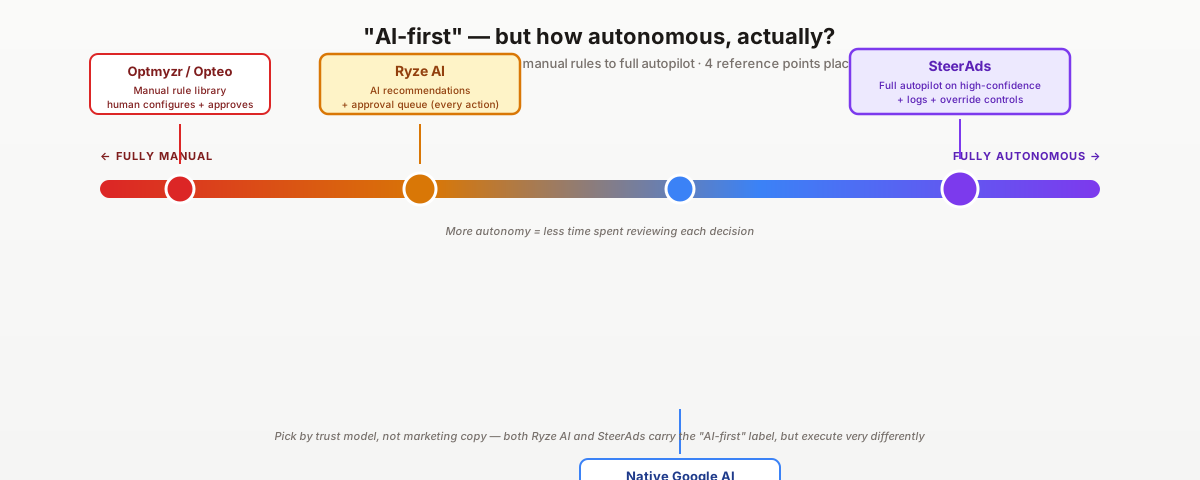
AI-first marketing claims: who delivers what
Both products use "AI-driven" / "AI-first" marketing. The substance differs. This table is the most important in this comparison:
The honest framing: if "AI-first" to you means "AI surfaces decisions and I review/approve them," Ryze AI matches that mental model. If "AI-first" means "the AI handles routine decisions autonomously and I supervise the system," SteerAds matches better. Neither is wrong; they're different product philosophies marketed under similar language.
Where Ryze AI genuinely wins
Three honest scenarios where Ryze AI is the right fit:
1. Teams that want explicit-approval AI assistance. If your team's culture is "AI surfaces, humans decide," Ryze AI's review-and-approve workflow matches that operating model. SteerAds's autopilot model requires comfort with delegating decisions to an AI baseline — for some teams, this is a non-starter regardless of cost.
2. Conversational PPC management via ChatGPT/Perplexity. The MCP integration is genuinely novel and useful for PPC managers who think in natural language ("show me underperforming keywords from last week and pause the worst three"). SteerAds doesn't expose this interface in 2026.
3. Multi-platform Google + Meta accounts (where SteerAds doesn't compete). If you need both Google Ads and Meta Ads optimization in a single tool, Ryze AI covers both. SteerAds is Google + Microsoft only — Meta is unsupported. For Meta-relevant accounts, Ryze AI is the multi-platform option in this comparison.
If your operating model isn't one of those three, the math points elsewhere.
Where SteerAds wins
Four scenarios where SteerAds is the better fit:
1. True hands-off autopilot. If you want the AI to actually make routine decisions automatically — not just surface them for your approval — SteerAds is built for that. Ryze AI explicitly keeps the human in the loop on every decision per reviewer feedback. Different product philosophy.
2. Pricing for SMB accounts. Ryze AI's $100/month entry tier is structurally higher than SteerAds's $14.90/month. For accounts spending under $30k/month, the price difference is meaningful — you're paying $1k+/year more for Ryze AI's review-queue model vs SteerAds's autopilot.
3. High-spend account stability. Ryze AI's reported "struggles at scale" issues vs SteerAds's design for sustained high-spend accounts. If you're managing $100k+/month in ad spend, the platform stability difference matters more than the price difference.
4. Microsoft Ads coverage. Ryze AI doesn't support Microsoft Ads (Bing/Yahoo/AOL). SteerAds does — at the same depth as Google. For accounts where 20%+ of spend touches Microsoft, this is binary. Run a free 14-day SteerAds audit on your account before deciding.
Migration cost & switching playbook
The Ryze AI → SteerAds migration is straightforward — both products use monthly billing, no contract friction. The 30-day playbook above (audit Ryze AI usage → connect SteerAds read-only → 14-day shadow → switch autopilot subset → decide on cancellation) is near-zero-risk.
The most useful data point during the migration is the review-time delta: how many minutes per day did you spend approving Ryze AI recommendations vs how many minutes per day with SteerAds's autopilot? If the delta is meaningful, the switching value is in time saved (not just dollars). For broader context, see our PPC in-house vs agency vs freelance comparison.
What G2 reviewers actually say (2026)
Aggregating themes across Ryze AI G2 reviews, Trustpilot, and 2026 third-party review aggregators:
Most-cited strengths:
- Speed to insight: actionable insights faster than traditional reporting tools.
- Reports clients understand: a real differentiator for agencies handling client-facing communications.
- Budget management efficiency: maintains budget pacing without constant manual oversight.
- ChatGPT/MCP integration: novel and praised by users who like conversational interfaces.
The dashboard is gorgeous and the ChatGPT integration genuinely useful — I can ask "what changed since last Tuesday" in plain English. But after three months I realized I was approving 95% of the recommendations without changing them. At that point I was paying for a very polished review queue, not for AI making decisions.
Most-cited frustrations:
- Manual approval still required: despite "AI" branding, every change requires human approval. Reviewers note this means "you're still making the decisions, just with better data presentation."
- Struggles at scale: performance and optimization quality reportedly degrade on high-spend accounts.
- No strategic onboarding: tool connects, runs analysis, generates suggestions — but doesn't understand your margins, competitive landscape, or business goals.
- Single-campaign focus: treats optimization as isolated tasks (this bid, that keyword) rather than holistic account strategy.
Best-fit user profile per reviewer consensus:
Ryze AI in 2026 is best for small-to-mid-sized advertisers running Google + Meta with $5-30k monthly spend who want AI-assisted decision-making (not autonomous AI). The fit weakens for: high-spend accounts ($100k+), teams wanting true autopilot, accounts where Microsoft Ads matters, and teams needing strategic onboarding.
Verdict by buyer profile
SMB on Google + Meta, want AI-assisted decisions: Ryze AI fits the operating model. $14.90 vs $100 is the question — if conversational ChatGPT interface matters to you, justify the price.
SMB on Google + Microsoft Ads, want true autopilot: SteerAds. Ryze AI doesn't cover Microsoft and doesn't deliver autopilot.
Mid-market on Google + Microsoft, $50-200k/month: SteerAds. Ryze AI's "struggles at scale" reports plus the missing Microsoft coverage make it the wrong fit.
Solo PPC freelancer with diverse client mix: Closer call. Ryze AI's per-account pricing scales with client wins. SteerAds's auto-tier pricing is more freelance-friendly for sustained portfolios.
Enterprise multi-channel brand: Neither alone — likely a multi-tool stack including SteerAds for Google + Microsoft, plus Bïrch or Madgicx for Meta + TikTok.
For a fuller competitive overview, see our SteerAds vs Ryze AI feature page, our AI replacing PPC managers: the false promise, or contact sales for an apples-to-apples enterprise quote.
Sources
Official sources consulted for this guide:
SteerAds auto-tier pricing reference ($ per month)
For full transparency on the comparison numbers cited above, here is the SteerAds auto-tier pricing reference that adjusts each cycle based on actual managed ad spend (Google + Microsoft Ads combined): Starter $14.90 (≤$500 spend), $29.90 (≤$1k), $59.90 (≤$2k), $129.90 (≤$5k), $259.90 (≤$10k), $499.90 (≤$20k), $1,099.90 (≤$50k), $1,999.90 (≤$100k), then $4,499.90 / $8,999.90 / $17,999.90 / $35,999.90 / $89,999.90 / $179,999.90 at increasing spend bands up to $10M. The price moves up if your spend rises into the next tier and back down if it drops — you never pick a tier manually and never get billed for capacity beyond your actual volume. See the live SteerAds pricing simulator to estimate your tier from your current monthly spend.
FAQ
Both Ryze AI and SteerAds market themselves as AI-first. What's the real difference?
The biggest practical difference is the autopilot model. Ryze AI's 2026 reviewer feedback consistently notes that despite the AI branding, every recommendation requires manual approval before changes go live — meaning the human is still making the decisions, just with better data presentation. SteerAds operates true autopilot: the AI baseline runs continuously and acts on high-confidence decisions automatically (with logs and override controls). Different trust models — neither is 'better' in absolute terms, but the difference matters for buyers who specifically want hands-off optimization vs AI-assisted decision-making.
Does Ryze AI's ChatGPT MCP integration matter in practice?
Mixed. The ChatGPT integration via Model Context Protocol (MCP) is genuinely novel — you can ask natural-language questions about your Google Ads account and have the AI execute commands. For PPC managers who like conversational interfaces, this is a real productivity feature. For teams that want optimization done automatically without conversation, it's marketing vs substance. SteerAds doesn't currently expose an MCP/conversational interface — the optimization happens in the autopilot layer, not via chat.
How does Ryze AI's $100/month entry tier compare to SteerAds's $14.90?
Roughly 6.7× higher at the Starter tier ($100 vs $14.90 for ≤$500 spend). Ryze AI's pricing scales with ad spend; SteerAds auto-tier scales proportionally to spend. For an SMB starting out, SteerAds is structurally cheaper. For a $100k+ spender, the gap shrinks because Ryze AI's pricing levels off and SteerAds auto-tier scales proportionally — but on the entry tier specifically, the SteerAds price advantage is real.
Is Ryze AI suitable for accounts spending more than $100k/month?
Reviewer feedback consistently notes Ryze AI 'struggles at scale' — performance and optimization quality degrade for high-spend accounts. The product seems designed for the $5k-$50k spend range. SteerAds's auto-tier pricing is more defensible at higher spend tiers, and the underlying AI architecture is built for sustained high-spend account management. For $100k+ accounts, evaluate carefully via parallel-run before committing.
What's the typical migration time from Ryze AI to SteerAds?
30 days. Both products use monthly billing (Ryze AI's pricing scales with spend but no long contracts). Day 1-3: connect SteerAds read-only alongside Ryze AI. Day 4-17: parallel-run shadow comparison, particularly comparing autopilot decisions vs Ryze AI's approve-each-recommendation workflow. Day 18-25: switch SteerAds to autopilot on a subset. Day 26-30: cancel Ryze AI if no regression detected.
Does Ryze AI handle Meta Ads as well as it handles Google?
Ryze AI markets multi-platform coverage (Google + Meta), but reviewer feedback skews heavily toward Google use cases. The Meta side is functional but less mature. For Meta-heavy accounts, Revealbot/Bïrch or Madgicx are more battle-tested options. SteerAds doesn't support Meta at all — different platform focus. If Meta is meaningful in your spend mix, neither SteerAds nor Ryze AI is the right exclusive choice.