
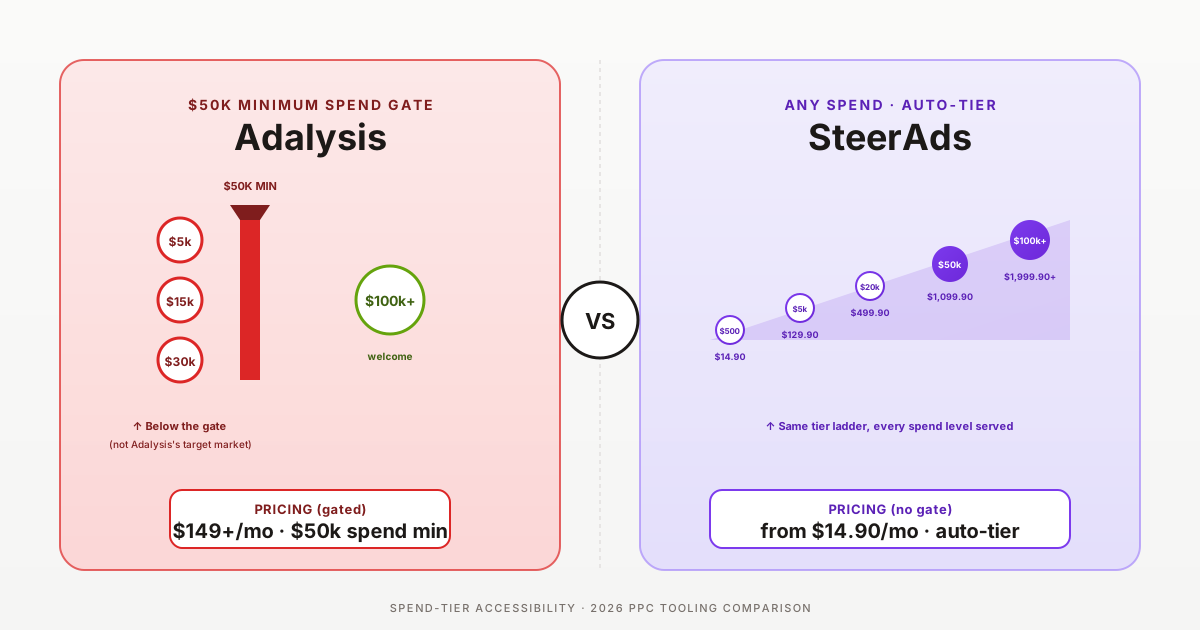

Adalysis sits in a distinctive position in the PPC tooling landscape: multi-platform like SteerAds (Google + Microsoft Ads), audit-heavy with 100+ pre-built checks, and pricing that starts where most accounts are seriously scaling — $50k+ in monthly ad spend. Adalysis pricing starts at $149/month for that entry threshold. SteerAds runs at from $14.90/month auto-tier from $0 spend up.
The structural difference: Adalysis is built around the rule-and-alert workflow with deep audit emphasis. SteerAds is built around continuous AI baseline + autopilot. They solve overlapping problems with different philosophies. This is an honest comparison with public sources.
Pricing comes from Adalysis's public pricing page (verified 2026). Reviewer themes are aggregated from G2, Capterra, SelectHub, and Software Advice. We do not cite private benchmarks or unverifiable user counts. Where a claim is opinion, we flag it as "in our experience."
Adalysis in 2026: snapshot
Adalysis launched as an ad-testing platform and matured into a full-stack PPC management suite covering Google Ads and Microsoft Ads. The product is distinctive for its audit depth — 100+ pre-built audit checks that surface optimization opportunities across budget, performance, bidding, keywords, search terms, and reporting axes. The Alerts surface is the daily-use entry point; users review surfaced issues and one-click apply fixes back to the underlying ad platform.
Adalysis explicitly targets agencies managing many accounts, with unlimited accounts and unlimited users at any pricing tier. The 30-60 day free trial is among the most generous in the category (extended for higher tiers). User satisfaction ratings (91% per SelectHub aggregation, 38 reviews) are strong but the consistent caveat is the learning curve — multiple reviewers note "overwhelming in the beginning" and "many features not utilized" because new users don't invest the upfront learning time.
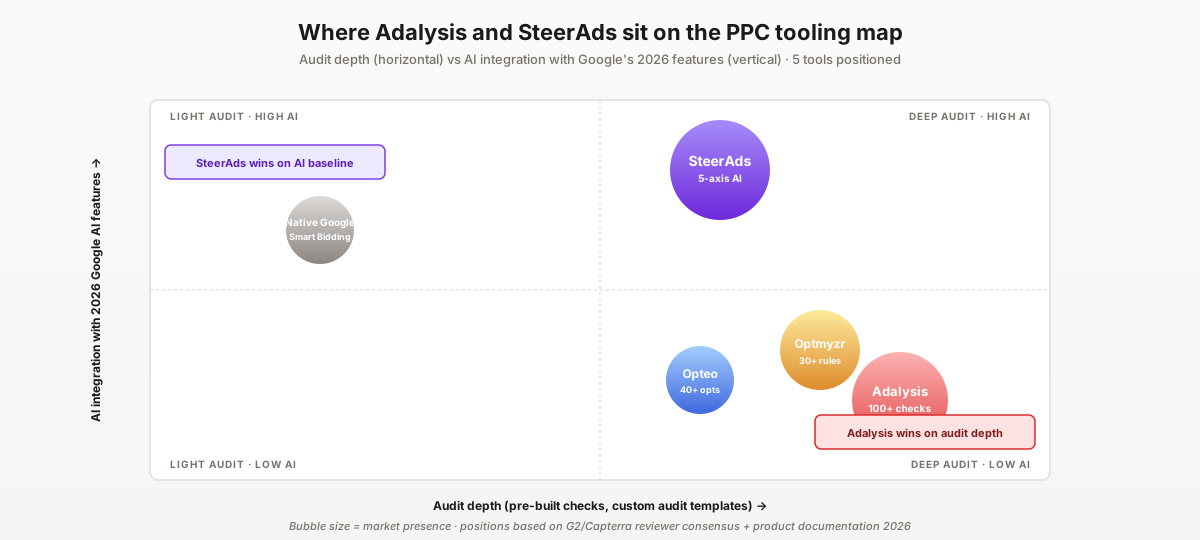
The 2026 weakness is AI integration. Adalysis's optimization model remains rule-and-alert based; it does not natively integrate with Google's AI Max for Search, does not autonomously generate ad copy, and does not auto-adjust bidding based on conversion data accumulation. For accounts that lean into Google's AI-driven campaign types, this is a real gap.
Pricing comparison (with sources)
Adalysis uses a single-tier pricing model that scales with ad spend, starting at $149/month for accounts at $50k+ monthly spend. SteerAds auto-tier scales proportionally to spend-rate, starting at $14.90/month (Starter) up to $1,099.90/mo at $50k spend.
For an account spending $50-100k/month, Adalysis's $149+/month pricing is accessible. For accounts under $50k spend, Adalysis isn't designed for you — SteerAds at $14.90/month is the rational fit. Above $200k spend, Adalysis pricing rises significantly, while SteerAds auto-tier scales proportionally. The crossover analysis depends on whether you need Adalysis's specific audit depth and white-label features enough to justify the price differential.
Feature parity (and the AI integration gap)
Both products cover Google + Microsoft Ads with rule-based audit and optimization workflows. The structural differences are AI integration depth and the optimization model philosophy.
The mental model: Adalysis is a deep audit platform with strong agency-shaped multi-account UX, optimized for teams willing to invest in learning the rule library. SteerAds is an AI autopilot that aims to replace the rule-configuration work with continuous AI baseline tuning. They're solving overlapping problems with different trust models — Adalysis trusts your rules; SteerAds trusts its AI.
Where Adalysis genuinely wins
Three honest scenarios where Adalysis remains the better fit, based on G2/Capterra reviewer patterns:
1. Audit-heavy agency workflows. If your team's value proposition to clients is "we run a 100-checkpoint audit every quarter and surface every issue," Adalysis is purpose-built for that. The 100+ pre-built checks plus customization capability make it the deepest audit platform in the category. SteerAds's 200+ checkpoint audit is comparable in breadth but less customizable per agency methodology.
2. White-label client reporting. Adalysis's white-label features — custom branding, per-client report templates, scheduled email exports — are agency table stakes. For agencies that bill on managed-service retainers and need polished client-facing deliverables, this is an Adalysis advantage. SteerAds's reporting is functional but not designed for resale.
3. Junior + senior team structure. Adalysis's rule-and-alert workflow lets junior account managers handle day-to-day optimization under senior strategist supervision. The explicit-approval model creates an auditable trail — important for agencies with onboarding/training programs and accountability frameworks. SteerAds's autopilot model is harder to integrate into a tiered-team structure.
If your operational model matches one of those, staying on Adalysis is rational.
Where SteerAds wins
Four scenarios where SteerAds is the better fit:
1. Sub-$50k monthly ad spend. Adalysis's pricing model literally starts at $50k spend — accounts below that aren't its market. SteerAds covers every spend tier on its auto-tier curve ($14.90 at Starter ≤$500, $129.90 at $5k, $499.90 at $20k), so SMB advertisers are served at a fair tier rather than excluded entirely. For SMB advertisers, this is binary.
2. AI-driven Google campaign types (Performance Max, Demand Gen, AI Max for Search). Adalysis's rule-based model lags on campaigns where Google's own AI handles much of the optimization. SteerAds's AI baseline adapts more cleanly to opaque-by-design campaign types. If 30%+ of your spend runs through PMax or Demand Gen, this matters.
3. Teams without dedicated PPC specialists. Adalysis's learning curve assumes someone on the team can invest multiple days into mastering the rule library. SteerAds's autopilot model assumes you don't have that person — the AI does the routine work, you intervene on edge cases. For ecommerce founders running their own ads, this is decisive.
4. Cost predictability at scale. A retailer scaling from $100k to $500k monthly ad spend will see Adalysis's pricing climb materially while SteerAds auto-tier moves from $499.90/mo (Pro) to ~$1,099.90/mo (≤$50k) as you scale. Total cost of ownership is predictable, simplifying budgeting and procurement. Run a free 14-day SteerAds audit on your account before deciding.
Migration cost & switching playbook
The Adalysis → SteerAds migration is structurally similar to Opteo: both use monthly billing, no annual contract risk, parallel-run is straightforward. The 30-day playbook above (audit existing config → connect SteerAds read-only → 14-day shadow → switch autopilot subset → decide) is near-zero-risk.
The interesting strategic question for some teams is "should I run both?" The case for running both:
- Keep Adalysis for the audit-heavy quarterly workflows and white-label client reporting
- Add SteerAds for autopilot on routine optimization between audits
- Total cost: $149/mo Adalysis + $14.90/mo SteerAds ≈ $164/mo — still cheaper than running Optmyzr Pro alone
The case against running both is the standard tool-sprawl argument: two systems making decisions on the same account creates conflicts. For most teams, picking one is the cleaner answer.
For broader context on PPC tooling decisions, see our in-house vs agency vs freelance comparison and the 2026 Google Ads agency cost guide.
What G2 and Capterra reviewers actually say (2026)
Aggregating themes across Capterra, Software Advice, and SelectHub in 2026:
Most-cited strengths:
- Audit depth and Alerts tab: pinpointing areas for improvement and one-click fixes, repeatedly cited as the strongest single feature.
- Multi-platform parity: Microsoft Ads workflow comparable to Google side, unusual in the category.
- Unlimited accounts/users at any tier: agency economics work cleanly.
- Customer support quality: knowledgeable, responsive — recurring positive theme.
The Alerts tab is genuinely the killer feature — we open it every morning and walk our junior account managers through three or four issues before lunch. But it took our newest hire three full weeks before she stopped feeling lost inside the platform.
Most-cited frustrations:
- Steep learning curve: "overwhelming in the beginning" appears repeatedly. Adalysis assumes team investment in mastering the rule library.
- UI density: "tons of things to click, easy to get lost without watching tutorials first."
- Limited AI integration: 2026 reviewers consistently note the gap to AI-first tools, especially on Google's newer campaign types.
- No native auto-generation of ad copy or AI Max integration: a real gap for accounts leaning into Google's AI features.
Best-fit user profile per reviewer consensus:
Adalysis in 2026 is best for agencies managing 10-100+ client accounts with a team capable of investing in the learning curve. The fit weakens for: solo accounts, teams without dedicated PPC expertise, sub-$50k spend accounts, and teams wanting AI-first optimization without rule maintenance.
Verdict by buyer profile
In-house PPC manager (single account, any spend): SteerAds. Adalysis's pricing model isn't designed for single accounts; the per-account economics never work in your favor.
Agency (10-50 accounts, audit-heavy methodology, white-label reporting required): Adalysis. The platform is built for your operational model. SteerAds's auto-tier pricing saves money but you'd need to layer in a separate reporting tool.
Agency (10-50 accounts, prefer autopilot to rule maintenance): SteerAds. Lower cost, less ongoing rule library maintenance, AI integration matches Google's direction better.
Solo freelance PPC manager (3-10 accounts, $50k+ aggregate spend): Closer call. Adalysis's unlimited-accounts pricing is freelance-friendly. SteerAds's auto-tier pricing is even more freelance-friendly. Decision turns on whether you bill clients on audit deliverables (Adalysis wins) or on managed performance (SteerAds wins).
Enterprise SaaS in-house team ($500k+ monthly spend): Closer call. Adalysis's audit depth is enterprise-grade. SteerAds's AI autopilot reduces team workload but may not match Adalysis's audit-checkpoint depth. Run both in a 60-day evaluation.
For a fuller comparison, see our SteerAds vs Adalysis feature page, our Google Ads agency cost guide, or contact sales for a multi-account quote.
Sources
Official sources consulted for this guide:
FAQ
How does Adalysis differ from Optmyzr or Opteo?
All three are rule-and-alert-based PPC optimization platforms, but the positioning differs. Optmyzr is the most established and most expensive (Pro at $499/month). Opteo is the most polished UI and Google-only. Adalysis sits in between — supports both Google AND Microsoft Ads (unlike Opteo), with broader audit depth (100+ checks) and a unified single-tier pricing model based on spend. For agencies needing multi-platform with audit emphasis, Adalysis's positioning is unique. SteerAds is the AI-first autopilot in a different category.
Does Adalysis integrate with Google's newer AI features (AI Max for Search, AI-driven ad copy)?
Limited. As of 2026 Adalysis does not natively integrate with Google's AI Max for Search features, does not autonomously generate ad copy, does not manage text customization settings, and does not leverage Final URL Expansion automatically. The Adalysis team continues iterating, but the platform's core philosophy remains rule-and-alert based. SteerAds was built around the AI baseline model and adapts more cleanly to Google's AI-driven campaign types. If you're heavily using Performance Max, Demand Gen, or AI Max, this gap matters.
Is Adalysis's $149/month entry tier accessible for small accounts?
The Adalysis pricing model starts at $50k monthly ad spend — accounts under that threshold are below the entry tier. For a small advertiser spending $5-30k/month, Adalysis's pricing structure isn't designed for you. SteerAds at $14.90/month is the rational choice for sub-$50k accounts. Above $50k spend Adalysis becomes interesting if you need its specific audit depth and multi-account management features.
How does Adalysis handle Microsoft Ads compared to SteerAds?
Both products support Google + Microsoft Ads in a single subscription. Adalysis reviewer feedback is positive on the Microsoft Ads side (the unified workflow is praised). SteerAds was built multi-platform from day 1 with the same depth on both surfaces. The practical difference is small at the audit/optimization-suggestion level; the larger difference is the optimization model (Adalysis rule-based, SteerAds AI autopilot). For pure Microsoft Ads coverage either works.
What's the typical migration time from Adalysis to SteerAds?
30 days, including a 14-day shadow comparison. Both products use monthly billing (Adalysis offers annual discounts but doesn't lock you in), so there's no contract friction. The interesting question for many teams is whether to migrate completely or run both in parallel — Adalysis for audit-heavy workflows + SteerAds for autopilot. Tool sprawl risk vs comprehensive coverage trade-off, evaluated per team.
Does Adalysis support white-label reporting for agencies?
Yes, white-label reporting is a core Adalysis feature targeted at agencies managing 10+ client accounts. SteerAds's reporting is functional but not white-label-grade — for agencies where white-label is contractual, this is an Adalysis advantage. Many agencies pair SteerAds with a separate reporting layer (Looker Studio, AgencyAnalytics) to get both the SteerAds optimization and the polished client-facing reports.