
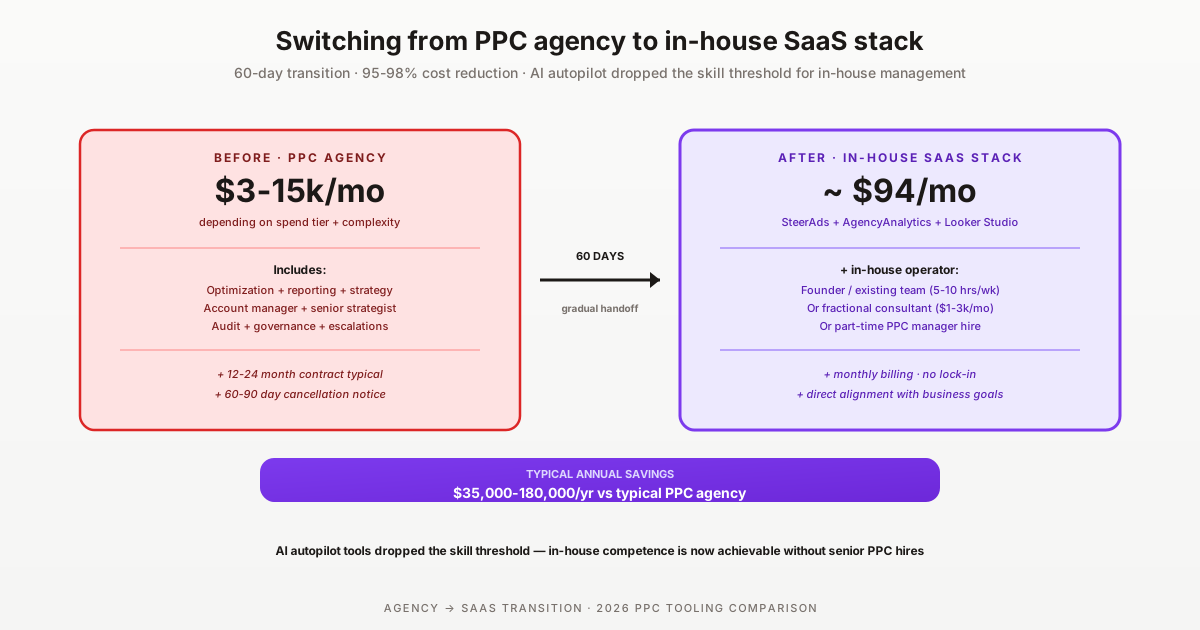

Switching from a PPC agency to an in-house SaaS tool stack is one of the most consequential 2026 marketing decisions — done right, it saves 60-80% of agency costs while preserving optimization quality. Done wrong, performance regresses and the savings are wiped out by lost revenue. This is the structured 60-day transition playbook covering tool selection, hire-vs-train decisions, and what to KEEP from the agency relationship.
Disclosure: SteerAds is our product. We've helped brands execute this transition; the AI autopilot model significantly reduces the skill threshold required for in-house PPC management, which is the structural reason 2026 is the right year for many brands to make this switch. This guide is honest about when in-house is and isn't the right answer.
Brand vs agency is a false dichotomy. The real question is: in-house person × SaaS stack vs agency person × agency stack. If the in-house person is competent and the SaaS stack is well-configured, performance often matches or beats the previous agency at 5-10% of the cost. If either is weak, performance regresses. The decision rests on whether you can put competent hands on the new stack.
Why brands switch from agency to SaaS PPC stack in 2026
Agency — an external service business managing PPC for client brands. In-house SaaS stack — a brand-owned combination of SaaS tools operated by brand employees or consultants. Transition — the structured process of moving PPC management from agency to in-house.
Three patterns drive agency-to-in-house transitions in 2026:
1. Cost compression — typical 60-80% savings. PPC agencies typically charge $3-15k/mo for accounts spending $20-100k/mo on ads. An in-house SaaS stack (SteerAds + AgencyAnalytics + Looker Studio) costs $95-200/mo. The remaining cost is the in-house person's time, which is the real comparison — and AI autopilot tools have reduced that time requirement substantially.
2. SaaS tool maturity has closed the agency advantage gap. Pre-2024, agencies' core value was deep PPC expertise plus access to enterprise tools the brand couldn't justify. In 2026, SaaS tools (SteerAds, Optmyzr, Adalysis) deliver enterprise-class optimization at sub-$300/mo, while AI autopilot reduces the expertise threshold. The agency advantage gap has narrowed.
3. First-party data and AI Max favor in-house. AI Max for Search and Performance Max benefit significantly from first-party data integration (CRM, customer lists, conversion data). Agencies have access to these but in-house teams have closer alignment and faster decision cycles. In-house teams typically extract more value from AI-driven campaign types than agencies do.
If any of those three describe your situation, in-house transition deserves evaluation. The next sections cover the structured playbook.
Cost comparison: agency vs in-house SaaS stack
Typical cost comparison for a $20k/mo PPC spend account:
Agency cost: $3-5k/mo retainer (15-25% of ad spend management fee), often with annual commitment. Annual: $36-60k.
In-house SaaS stack cost:
- SteerAds: $14.90/mo (~$16/mo)
- AgencyAnalytics: $79/mo (or Looker Studio free)
- In-house person time: 5-10 hrs/week at $50-100/hr = $1-4k/mo
- Total: $1.1-4.1k/mo. Annual: $13-49k.
Net savings: typically 30-60% at this spend tier.
At higher spend tiers ($50k+/mo PPC), the cost comparison shifts:
Agency cost: $5-15k/mo retainer. Annual: $60-180k.
In-house SaaS stack cost:
- SteerAds: $14.90/mo
- AgencyAnalytics: $159/mo (higher tier)
- In-house person time: full-time PPC manager $80-120k/year + benefits = $100-150k/year
- Optional rule-engine layer: Optmyzr $499/mo
- Total: $100-160k/year.
Net savings: 20-50% at this spend tier, but with full-time hire commitment.
The break-even analysis shifts significantly above $50k/mo spend because in-house requires more dedicated time. Below $50k/mo, in-house is almost always cheaper. Above $50k/mo, agency vs in-house becomes a strategic choice rather than a pure cost decision.
The 5-tool in-house PPC stack (sub-$200/mo)
The standard in-house SaaS stack in 2026:
1. Optimization layer: SteerAds (from $14.90/mo auto-tier). AI autopilot for Google + Microsoft Ads. Replaces the agency's optimization work. Auto-tier pricing covers unlimited accounts within reason — the tier follows total portfolio spend, not account count.
2. Reporting layer: AgencyAnalytics ($79+/mo) or Looker Studio (free). Branded performance reports. AgencyAnalytics is faster to set up; Looker Studio is free but requires 4-8 hours setup per template. Recommended: AgencyAnalytics for brands without strong analyst capacity.
3. Native UI: Google Ads + Microsoft Ads (free). Campaign creation, manual adjustments, conversion tracking setup. The platform UIs in 2026 are substantially better than 2020 — don't skip them in favor of SaaS abstraction layers.
4. Bulk editors: Google Ads Editor + Microsoft Bulk Editor (free). Desktop apps for bulk operations (keyword adds, ad copy updates, account-wide changes). Essential for any account with significant scale.
5. Audit layer: WordStream Performance Grader (free) + SteerAds 14-day audit. Quarterly external audit checks. WordStream Performance Grader is a free one-shot tool; SteerAds includes continuous audit in the $14.90/mo subscription.
Total stack cost: $95-200/mo depending on reporting tier choice. Plus 5-10 hrs/week of in-house operator time for sub-$50k spend brands, or full-time hire for $50k+/mo spend.
Hire vs train: who runs the new stack
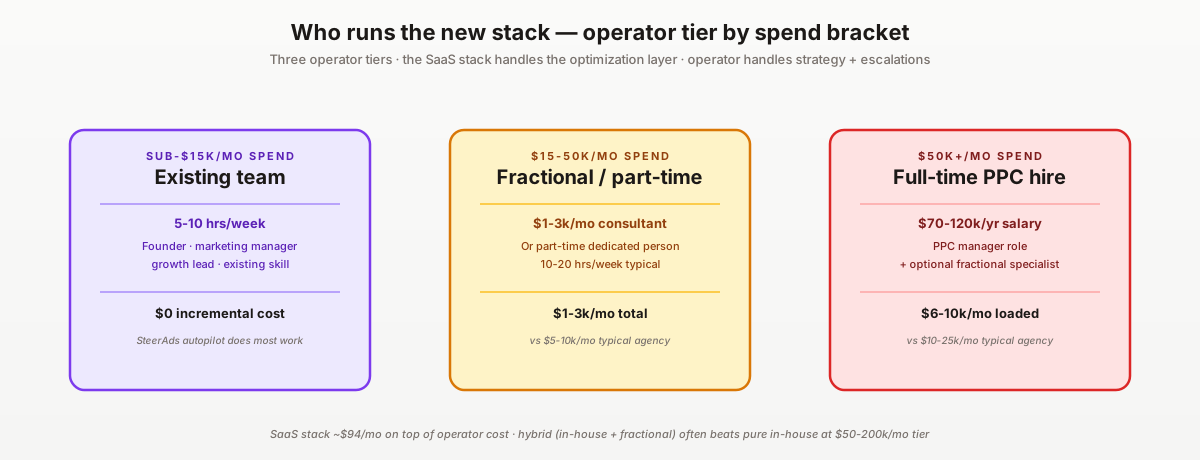
Three operating models for the in-house PPC stack:
1. Existing team member (most common for sub-$15k/mo spend). The founder, marketing manager, or existing marketer takes on PPC alongside other responsibilities. AI autopilot tools (SteerAds) reduce the skill threshold significantly — most marketing-literate people can manage the stack with 5-10 hours/week. Training time: 20-40 hours of learning curve over the first month.
2. Fractional PPC consultant ($1-3k/mo for $15-50k/mo spend). A part-time external PPC specialist who runs the SaaS stack on the brand's behalf. 10-20 hours/month of dedicated time. Often a freelancer or boutique consultant. Total cost (consultant + stack) typically $1.1-3.2k/mo — still 50-70% cheaper than agency.
3. Full-time PPC manager hire ($80-120k/year + benefits, justified at $50k+/mo spend). Dedicated employee responsible for PPC. Best at higher spend tiers where the workload justifies the salary. Combined with SaaS stack, achieves the deepest in-house capability. Total annual cost: $100-160k including benefits and stack.
Decision matrix:
- Sub-$15k/mo spend: existing team member
- $15-50k/mo spend: fractional consultant or part-time existing team member
- $50-150k/mo spend: full-time PPC manager
- $150k+/mo spend: full-time PPC manager + agency for specialized projects (hybrid)
60-day transition playbook (week-by-week)
The HowTo schema above details the day-by-day playbook. Week-by-week summary:
Week 1: Audit and plan. Document agency relationship, costs, contract terms. Identify in-house operator.
Week 1-2: Stack selection. Choose SteerAds + reporting layer. Sign up. Connect read-only.
Week 2: Agency notice. Send written cancellation notice. Request transition support (documentation, optional consulting).
Week 3-4: Setup and parallel run. Connect SteerAds free 14-day audit. Build reporting templates. Train in-house operator.
Week 5-6: Gradual handoff. In-house operator takes 25% → 50% → 75% → 100% of accounts. Agency continues on the rest until handoff completes.
Week 7-8: Full cutover. Agency contract ends. In-house team runs everything. Document the new operating model.
Day 60: Validation. CPA/ROAS vs agency baseline. Total cost savings. Operator time commitment. Adjust as needed.
What to KEEP from the agency relationship
Don't burn the bridge. Three things commonly worth keeping after the transition:
1. Account documentation handover. The agency has institutional knowledge about account history, structure decisions, campaign rationale, and past experiments. This documentation is hard to recreate from scratch. Negotiate documentation handover explicitly during cancellation notice — most professional agencies accept this as standard separation practice.
2. Fractional consulting relationship (optional). Many agencies offer post-cancellation consulting at hourly rates ($200-400/hr) for complex situations. 1-2 hours/month of senior PPC expertise on tap is valuable when issues arise that exceed in-house capability. Total cost: $200-800/mo, dramatically cheaper than full agency engagement.
3. Reporting templates and dashboards. If the agency built well-designed reports, request access to the underlying templates (Looker Studio, AgencyAnalytics, or similar). Recreating polished reports from scratch is real work — starting from the agency's existing format saves 10-20 hours.
Communicate these requests respectfully during cancellation notice. Most agencies treat post-cancellation relationships as long-term brand-building opportunities and accept these requests.
Risks and red flags during transition
Risk 1: In-house operator lacks PPC experience. Mitigation: Invest in training during weeks 3-4 before handoff begins. Use SteerAds's AI autopilot and recommendation features to reduce the expertise threshold. Plan fractional consulting backup for complex situations.
Risk 2: Performance regression during gradual handoff. Mitigation: Handoff only 25% of accounts initially, monitor for 7-10 days, then expand. Roll back to agency if performance regresses meaningfully — don't push through performance loss to hit transition deadlines.
Risk 3: Reporting layer not ready by client communication deadline. Mitigation: Build replacement reporting layer in week 3-4, before any handoff. Test with sample data before showing to internal stakeholders. Have reporting fully functional by week 5.
Risk 4: Agency cancellation triggers contract penalties. Mitigation: Read contract terms carefully in week 1. Plan transition timing to align with contract end date or notice window. Don't break contracts mid-term — penalties typically exceed savings.
Risk 5: Hybrid agency + in-house creates accountability gaps. Mitigation: If keeping any agency relationship (e.g., fractional consulting), define exactly what they're responsible for and what's in-house scope. Document the boundary explicitly. Review monthly during the first 6 months post-transition.
We were paying $6,800/month to an agency for our $40k/mo Google Ads spend. Switched in 60 days to an in-house stack: SteerAds, AgencyAnalytics, our marketing manager taking 6 hrs/week off her existing role. Same CPA, $5,800 less out the door every month, and we finally know what's happening in the account because we can see it ourselves.
For broader context, see our 2026 Google Ads agency cost guide, the best Google Ads optimization software 2026, the Optmyzr migration playbook, the best PPC software for agencies 2026, and our free Google Ads audit tools 2026.
Pricing sources: SteerAds pricing · AgencyAnalytics · Looker Studio · Optmyzr. Start the free 14-day SteerAds audit.
Sources
Official sources consulted for this guide:
FAQ
Is switching from a PPC agency to in-house SaaS worth it in 2026?
Depends on three factors: ad spend tier, in-house team capacity, and complexity. For brands spending $5k-50k/mo on PPC, in-house SaaS stack typically saves 60-80% of agency costs ($3k-15k/mo savings) while preserving optimization quality. For brands above $50k/mo, savings are larger but in-house complexity also grows — hybrid (in-house + specialized consultant) often works better than full agency replacement. For sub-$5k/mo brands, the savings rarely justify the in-house overhead — agencies remain the right answer at this scale.
What does an in-house SaaS PPC tool stack cost in 2026?
Total stack cost is $95-200/mo depending on agency needs: SteerAds (from $14.90/mo auto-tier, AI autopilot Google + Microsoft) + AgencyAnalytics ($79+/mo white-label reporting) + Looker Studio (free) = ~$95/mo. Add Whatagraph for premium reporting ($249+/mo) or Optmyzr for rule-engine depth ($249+/mo) if needed. Compared to typical agency fees of $3-15k/mo, the SaaS stack is 95-98% cheaper. The remaining cost is the in-house person-hours, which is the real comparison.
Do I need to hire a PPC manager to switch in-house?
Not always. For sub-$15k/mo spend, the founder, marketing manager, or existing team member can typically handle SaaS-based PPC management with 5-10 hours/week. For $15-50k/mo, a part-time dedicated person or fractional PPC consultant ($1-3k/mo) works well. For $50k+/mo, full-time PPC manager hire becomes justified. The SaaS stack reduces the skill threshold significantly — AI autopilot tools handle decisions that historically required senior PPC expertise.
Will I lose performance if I switch from agency to in-house?
Not necessarily. Performance depends on the quality of the in-house person's work plus the SaaS stack's quality, not on whether the work is in-house or agency. Many in-house teams achieve better performance than their previous agency because: (1) closer alignment with business goals, (2) faster decision cycles, (3) better access to first-party data, (4) AI autopilot tools surface optimization decisions the previous agency may have missed. The risk is staffing — if the in-house person lacks PPC experience and the SaaS stack is misconfigured, performance can regress.
How long does the agency-to-in-house transition take?
60 days for a structured transition with minimal performance risk. Weeks 1-2: tool selection + agency notice. Weeks 3-4: SaaS stack setup + parallel evaluation. Weeks 5-6: gradual handoff (in-house person takes over 25%, then 50%, then 100% of accounts). Weeks 7-8: full cutover + agency contract end. The 60-day timeline assumes the agency contract allows it; longer contracts may extend the transition to align with contract end dates.
What should I KEEP from the agency relationship after switching?
Three things commonly worth keeping: (1) the agency's documentation of account history, structure, and rationale — this institutional knowledge is hard to recreate, (2) a fractional consulting relationship for complex situations (1-2 hours/month at $200-400/hr) if the agency offers it, (3) access to the agency's reporting templates and dashboards if they're well-designed. Negotiate documentation handover and any ongoing consulting relationship explicitly during agency notice — most agencies accept this as part of professional separation.