

Adalysis is the deepest audit platform in the multi-platform PPC tooling category — 100+ pre-built audit checks, Google + Microsoft Ads native support, unlimited accounts and users at any tier. But 2026 reviewer feedback consistently surfaces three friction points: $50k+ minimum spend pricing barrier, limited AI integration with Google's newer features, and a steep learning curve that creates onboarding friction for junior team members.
This is an honest ranked breakdown of the 9 most credible Adalysis alternatives in 2026, with public-source pricing and verdict by buyer profile. Disclosure: SteerAds is one of the alternatives covered — it directly addresses Adalysis's pricing tier limitation while delivering AI autopilot Google + Microsoft Ads coverage.
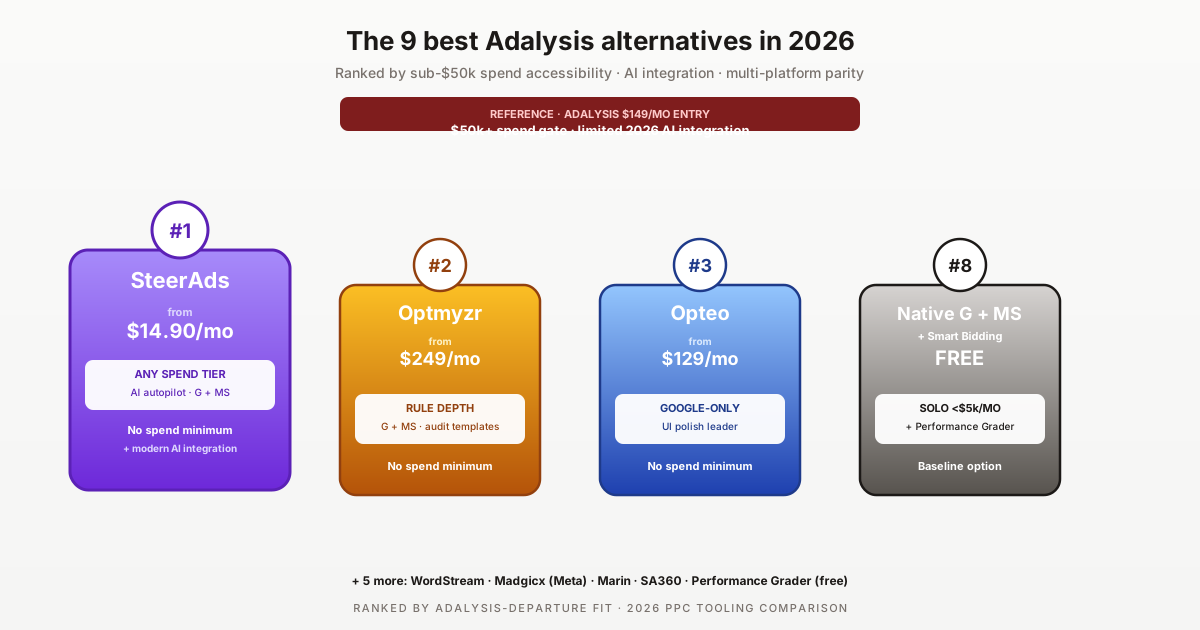
Adalysis's pricing model starts at $50k monthly ad spend ($149/mo entry tier). Sub-$50k accounts aren't its target market regardless of feature comparison. If your scale is below this threshold, alternatives like SteerAds (from $14.90/mo auto-tier) are not just cheaper — they're the only credible option. If you're above $50k/mo, the comparison shifts to feature trade-offs.
Why look beyond Adalysis in 2026
Adalysis remains a credible product for audit-heavy enterprise agencies — the 100+ checkpoint depth is genuinely best-in-class, and customer support quality is consistently praised. But three friction points push 2026 buyers toward alternatives:
1. $50k+ minimum spend pricing barrier. The pricing model literally starts at $50k monthly ad spend. Many agencies have client portfolios with most accounts well below this threshold. SteerAds auto-tier starts at $14.90/mo (Starter ≤$500 spend) and scales with your tier — the floor matters when your portfolio is mixed.
2. Limited AI integration with Google's newer features. As of 2026, Adalysis does not natively integrate with Google's AI Max for Search, does not autonomously generate ad copy, and does not auto-adjust bidding based on conversion data. The platform's core philosophy remains rule-and-alert. SteerAds was built around AI baseline + autopilot and adapts more cleanly to Google's AI-driven campaign types.
3. Steep learning curve creates onboarding friction. Reviewers consistently note "overwhelming in the beginning" and "many features not utilized" because new users don't invest the upfront learning time. For agencies with junior team members or rapid hiring, the onboarding cost compounds.
If any of those three describe your situation, the alternatives below deserve evaluation.
The 9 best Adalysis alternatives
#1 — SteerAds ($14.90/mo, AI autopilot)
Best for: Sub-$50k spend brands + AI-first optimization model
The most direct fix for Adalysis's pricing tier limitation + AI integration gap. Multi-platform Google + Microsoft Ads with continuous AI baseline + autopilot. auto-tier pricing from $14.90/mo (scales with spend, e.g. $129.90 at $5k, $1,099.90 at $50k) solves the entry threshold issue. Free 14-day audit, no credit card. Full SteerAds vs Adalysis comparison.
#2 — Optmyzr ($249-499/mo, established rule library)
Best for: Agencies wanting Adalysis-class rule depth at clearer pricing
Multi-platform Google + Microsoft Ads with mature rule library. More expensive than Opteo's Basic tier but offers deeper rule customization than Adalysis's audit-focused approach. 30-day money-back guarantee on first-time subscriptions. Optmyzr pricing.
#3 — Opteo ($129-499/mo, Google-only polish)
Best for: Google-only agencies that prize UI quality
Cleaner UI than Adalysis with comparable Google-side optimization depth. Structural limit: Google Ads only, no Microsoft Ads. For Google-only agencies frustrated with Adalysis's complexity, Opteo's polish is a real productivity factor. Opteo pricing.
#4 — WordStream Advisor ($15-49k/yr actual)
Best for: Brands needing the WordStream brand for procurement
Multi-platform Google + Microsoft Ads but with significant pricing opacity, annual contracts, and feature stagnation since LocaliQ acquisition. Worth evaluating only if procurement specifically requires the brand. SteerAds vs WordStream.
#5 — Madgicx ($44-99/mo, Meta-only)
Best for: Brands shifting toward Meta-heavy spend
NOT a direct Adalysis replacement — Madgicx is Meta-first AI with Google reporting only. Listed because Adalysis customers reducing search spend in favor of Meta should evaluate Madgicx for the social side. Madgicx pricing.
#6 — Marin Software ($500+/mo, enterprise cross-channel)
Best for: Enterprise advertisers ($100k+/mo) needing cross-channel reporting
Marin's MarinOne consolidates Google + Microsoft + Meta + Amazon. Worth considering only if you're scaling UP from Adalysis to enterprise multi-channel.
#7 — Search Ads 360 (2-4% of spend, Google enterprise)
Best for: Enterprise brands committed to Google Marketing Platform
SA360 is Google's premium enterprise search platform. Partner-channel only, 3-6 month implementation. Same enterprise-only constraint as Marin.
#8 — Native Google + Microsoft Ads UI (free)
Best for: Sub-$5k/mo solo accounts
Native platform UIs have substantially closed the gap on what early Adalysis-class tools were built to replicate. For sub-$5k/mo accounts, the cost of any paid tool may exceed the optimization lift. Pair with the WordStream Performance Grader for a free periodic audit.
#9 — Google Ads Performance Grader (free)
Still useful as a periodic audit replacement
The Performance Grader (free, no signup, by WordStream) is a 60-second audit tool that covers many of the audit findings Adalysis surfaces — not as deep as 100+ checkpoints but free and externally credible. Pair with SteerAds's free 14-day audit for a fuller view.
Side-by-side comparison table
Decision matrix by buyer profile
Sub-$50k/mo agency or solo brand: SteerAds. Adalysis isn't designed for your scale.
$50-200k/mo mid-market agency, audit-heavy methodology: Stay on Adalysis if audit depth is contractually critical. Otherwise SteerAds saves significantly.
$50-200k/mo mid-market agency, autopilot-friendly: SteerAds. Lower cost, AI-first model matches Google's direction better.
Enterprise agency ($500k+/mo): Marin Software OR SA360 if scaling UP from Adalysis. SteerAds + a separate reporting layer (Looker Studio) is also viable for cost-conscious enterprise.
DTC brand on Meta + Google + Microsoft: SteerAds for search + Madgicx (or Bïrch) for Meta. Combined ~$115/mo replaces Adalysis's $149+/mo for full multi-platform coverage.
Solo PPC manager (single account, sub-$50k spend): SteerAds at $14.90/mo is the only economically rational paid option.
Cheap Adalysis alternatives (sub-$50/mo)
Below the $50/month threshold:
- SteerAds (from $14.90/mo, auto-tier) — auto-tier AI autopilot Google + Microsoft Ads (from $14.90/mo)
- Madgicx Essentials ($44/mo for sub-$2.5k spend) — Meta-only, basic features
- Native Google + Microsoft Ads UI (free) — Smart Bidding + Recommendations API + native Microsoft tools
- Google Ads Performance Grader (free) — periodic external audit
For genuine multi-platform audit + automation in the sub-$50 paid tier, SteerAds is essentially the only option.
Tools with stronger AI integration than Adalysis
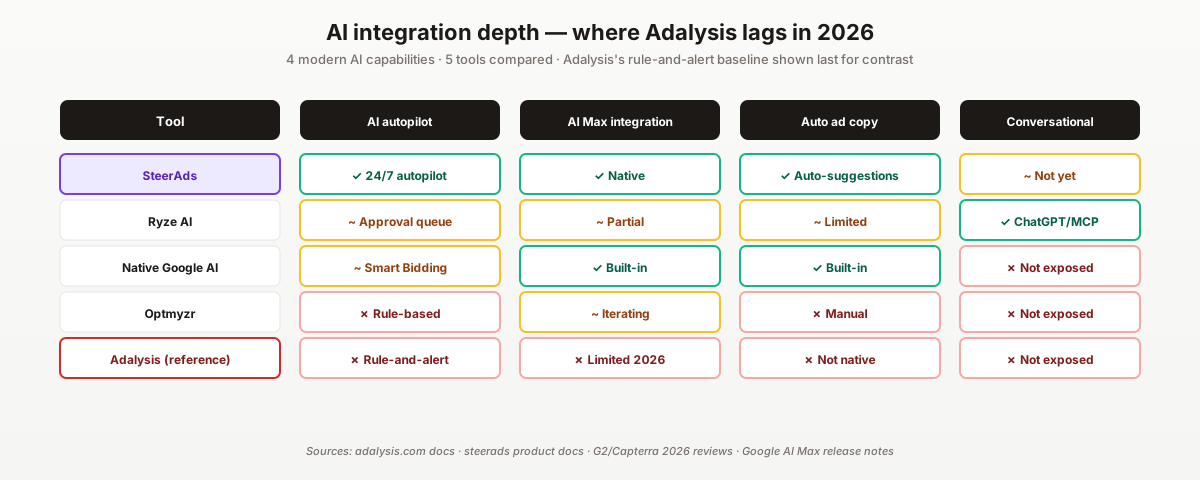
If the Adalysis migration driver is the AI integration gap specifically:
- SteerAds — built around AI baseline + autopilot, adapts to Google's AI Max + Performance Max + Demand Gen
- Madgicx — AI Audiences + creative AI for Meta (different platform)
- Skai — Celeste generative AI agent for omnichannel (enterprise pricing)
- Native Google Ads Smart Bidding + AI Max — built into the platform, free
For Google + Microsoft Ads accounts wanting modern AI integration without enterprise pricing, SteerAds is the most direct path.
Migration playbook: leaving Adalysis
The HowTo schema above details the 30-day playbook. Three additional considerations specific to Adalysis departures:
Audit-depth replication is the biggest switching cost. Adalysis's 100+ pre-built checks are unique. SteerAds's autopilot may catch the same patterns but doesn't display them as checklist items. If client deliverables reference audit checklists, this gap requires bridging (Looker Studio + custom dashboards).
Junior team training shifts. Adalysis's rule-and-alert workflow lets junior staff operate under senior supervision with explicit audit trails. SteerAds's autopilot model assumes more delegation to AI. Rethink team workflows accordingly.
White-label reporting may need a separate layer. Adalysis's white-label features support agency client reporting natively. SteerAds + Looker Studio (free) or AgencyAnalytics ($79+/mo) covers this gap if you can layer the tools.
The Adalysis Alerts tab and 100+ audit checks are genuinely best-in-class — we used them as quarterly client deliverables for two years. But at $149/mo per account threshold, we couldn't onboard the sub-$50k clients we were winning in 2025. We shifted those accounts to SteerAds at $14.90/mo and kept Adalysis for the legacy enterprise book.
For broader context, see our SteerAds vs Adalysis breakdown and the 2026 Google Ads agency cost guide.
Pricing sources: Adalysis pricing · Optmyzr pricing · Opteo pricing · G2 PPC category. Run a free 14-day SteerAds audit.
Sources
Official sources consulted for this guide:
FAQ
What's the most direct Adalysis replacement at lower price tiers?
SteerAds (from $14.90/mo auto-tier) is the cheapest alternative covering Google + Microsoft Ads with AI autopilot — solving Adalysis's $50k+ minimum spend tier requirement. Optmyzr ($249-499/mo) is the closest functional alternative on rule-engine depth + multi-platform coverage. Opteo ($129+/mo) is cleaner UI but Google-only. The right choice depends on whether you need Adalysis's specific audit depth (then stay) or just routine optimization (then SteerAds wins on cost).
Why are agencies leaving Adalysis in 2026?
Three patterns: (1) entry tier requires $50k+ monthly ad spend — accounts below that aren't its market and many agencies have client portfolios under that threshold, (2) limited AI integration with Google's newer features (no AI Max for Search, no auto ad copy generation, no auto-bidding from conversion data), (3) steep learning curve creates onboarding friction, especially for junior team members. AI-first alternatives (SteerAds) and lower-tier rule-based tools (Optmyzr, Opteo) are the most common destinations.
Is Adalysis still worth it for established agencies?
Yes, in three scenarios: (1) Audit-heavy methodology where the 100+ pre-built checks are contractually expected by clients, (2) White-label reporting requirements at multi-client scale, (3) Junior + senior team structure where the rule-and-alert workflow lets juniors operate under senior supervision. Outside these, alternatives win on cost (SteerAds), AI integration (SteerAds, Ryze AI), or accessibility (Opteo, Optmyzr).
Does any Adalysis alternative match its 100+ audit check depth?
Optmyzr's audit feature is the closest match (extensive rule library, customizable audit templates) but with similar pricing tier ($249-499/mo). SteerAds offers a 200+ checkpoint 5-axis audit but the focus is autopilot execution rather than rule-by-rule audit display. For pure audit-comparison-with-clients use cases, Adalysis remains the depth leader — the alternatives are stronger on automation but lighter on audit display.
What's the cheapest Adalysis alternative for sub-$50k spend accounts?
SteerAds at from $14.90/mo auto-tier — the only multi-platform paid alternative below $100/mo. Native Google Ads + Smart Bidding + native Microsoft Ads UI (free) covers the platform-execution side without paying for tooling. For sub-$50k spend brands, Adalysis isn't the right fit regardless — its pricing model is built for $50k+ monthly spend.
What's the migration time from Adalysis to a SteerAds-class alternative?
30 days. Adalysis uses monthly billing (with 10% off 6-month, 15% off annual prepay). No annual lock-in. Day 1-3 connect SteerAds read-only alongside Adalysis. Day 4-17 14-day shadow comparison on Google + Microsoft accounts. Day 18-25 switch SteerAds autopilot on subset. Day 26-30 cancel Adalysis if no regression. The harder migration step is replicating Adalysis's audit checklist into the alternative — many checks have direct equivalents in SteerAds's autopilot decisions, but not all surface visibly.